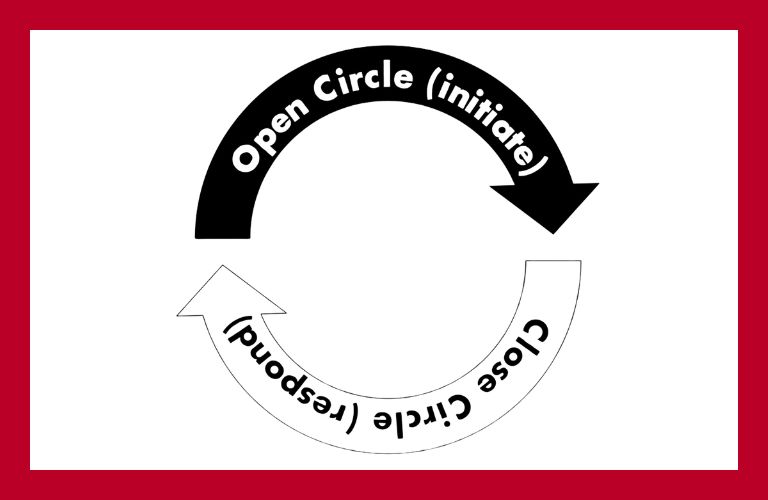
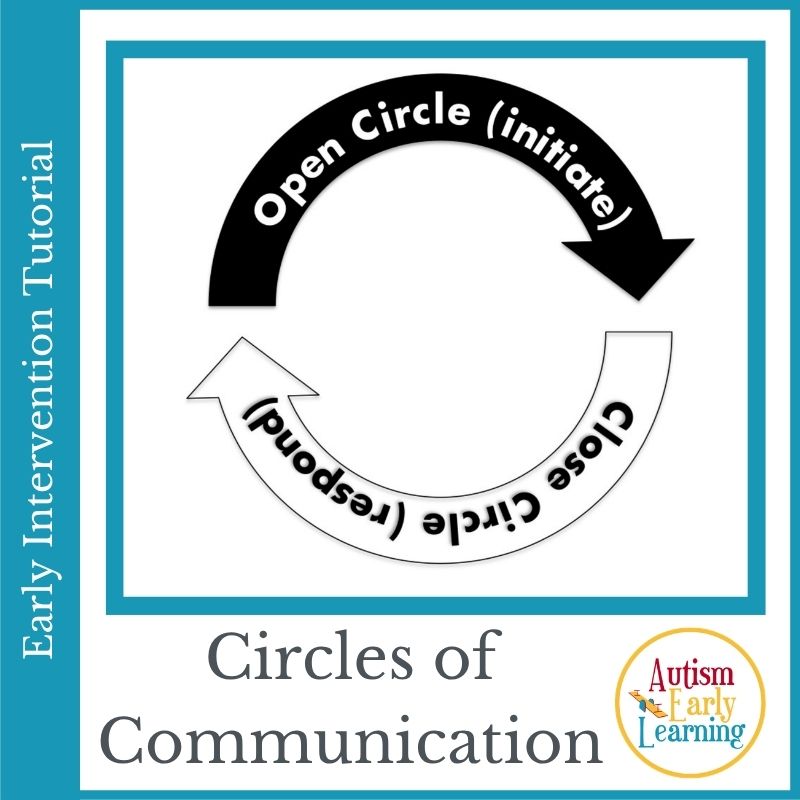
The first half of the circle is the initiation (someone knocks on the door) and the second half is the response (someone else opens the door). There are all different sizes of circles. Some are big and obvious, and some are more subtle. There are times that we may miss them if we’re not paying close attention.
A big circle might be calling someone’s name and them turning around and saying “what?” A smaller circle might be when you’re playing chase and your child glances back at you to see if you’re still coming. A really subtle circle might be when you say “I’m gonna get you!” and the child’s eyes widen.
Circles can be tricky to count at times, but the important thing is just recognizing this back and forth interaction. As we look at our world around us, it is all about these back and forth interactions with others. Relationships are based on these back and forth interactions. Think of all the things that require circles of communication. Most learning involves a back and forth interaction whether it’s imitating or following directions.
Circles do not have to be verbal circles, a kid who does not talk yet can get hundreds of back and forth circles without saying a word. How do we do it? We do it through PLAY. It is important that as children learn to increase their circles of communication that we are giving them opportunities to express themselves on their own. We can tell a kid what to do every step of the way, but how much more rich and motivating would it be if the child is giving us cues of what they want instead. We need to follow their lead.
A Balance Of Opening and Closing Circles
Sometimes kids may be good at closing circles but opening circles is more difficult. Other kids may be opposite where they can open circles, but don’t respond (closing the circle) when someone else opens a circle. And some kids may find both challenging.
When I first meet with a family, I always spend 15-20 minutes just watching them play. As adults, we like to lead the play a lot. We give a lot of directions and we ask a lot of questions. We’re really good at opening circles. When we do that, we’re only allowing the child to close circles. We want a balance, and in the beginning we may actually want the child opening circles more than closing. We want them to be motivated to communicate.
Having these circles of communication is really important, and is a pre-requisite to having conversations, or engaging in higher levels of play. Try to count how many consecutive circles your child has a time, and try to expand on that. If there’s so many it’s hard to count, great! Instead of working on the quantity of cirlces, start to work on the quality.
Circles of Communication Tutorial
Once you purchase the Circles of Communication Tutorial and log in, you will have full access to all the content below this section.
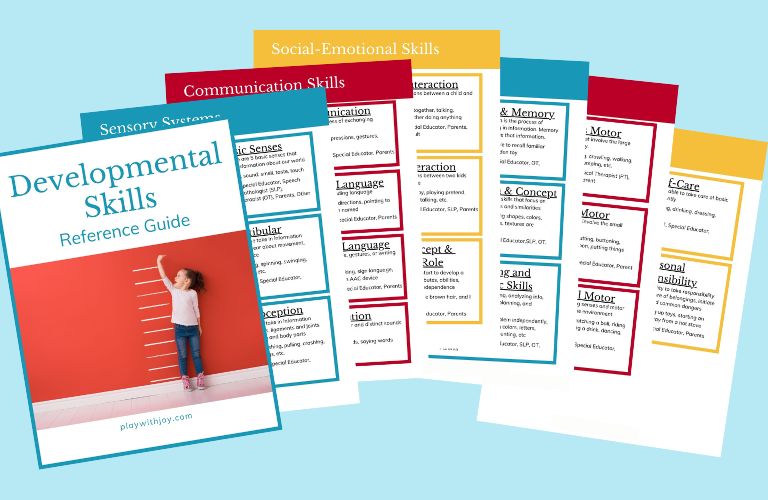
Get Your Free Developmental Skills Reference Guide
Parents, educators, and therapists – Add this to your toolbox to better understand key areas of child development. Plus get extra tips, activities and strategies to your inbox.
Unsubscribe at any time. See Privacy Policy for more details.