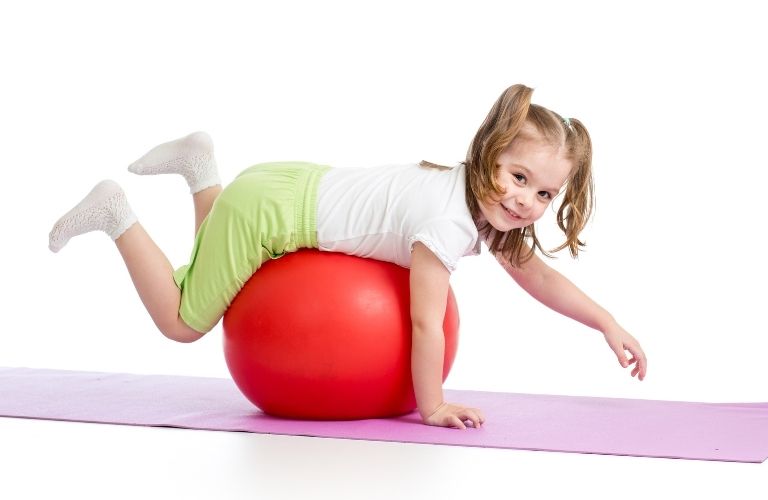
An exercise ball is one of my must-haves when working in Early Intervention or Preschool Classes. This is a great activity IF your child enjoys vestibular or proprioceptive input. If your child avoids these types of activities, you can still try it, but you’ll need to be sensitive to your child’s preferences and go at a much slower pace
I have found that using a lot of sensory motor activities not only increases engagement (because it’s fun!) but it also increases communication and motivation.
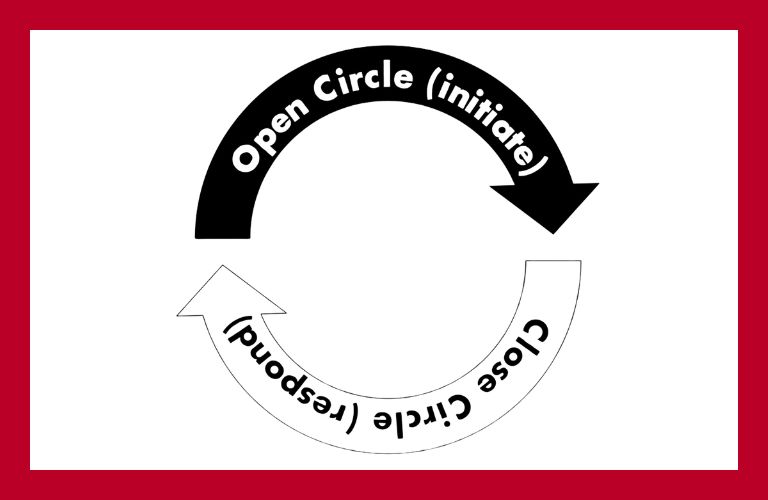
I’ve had several kids I’ve worked with that have started initiating (opening circles) more and using more words just from doing activities like bouncing on a ball.
What you want to do first is create some type of sequence or routine. For example if your child likes to sit on top of the ball and have you bounce him, then do that. The sequence may look something like this:
Put your child on the ball and say “up” or “on”
Say “1,2,3, Go”
Start bouncing
Sing a song or just melodically and rhythmically say “bounce, bounce, bounce”
Say “stop” and stop bouncing
Take your child off the ball
If this is the first time you’re doing the activity, then set up the sequence by doing it several times until you know your child is engaged and wants more. Once your child is fully engaged, then the next time you finish the sequence just wait. Don’t say anything, just use facial expressions.
As soon as your child does anything to indicate he wants more, then put him on the ball. This can be anything, your child may use a full sentence to ask more, or your child may try to get on the ball by himself. Whatever your child does, don’t discount it. This is communication.
Sometimes adults will discount a child’s attempt at communication just because it’s not how the adult wants the child to do it. Please don’t do this. Our goal with this activity is to get more and more circles of communication (initiating and responding). If you ignore your child’s attempt to communicate, you’re stopping the flow and thus forfeiting him the chance to increase those circles.
As your child increases his consecutive circles of communication, and as his motivation increases, you just might hear more verbal words as well.
Using an exercise ball in Early Intervention is not only good for communication, but it can be calming for kids that are disregulated. You can also use an exercise ball to work on cognitive skills, motor skills, and even pretend play.
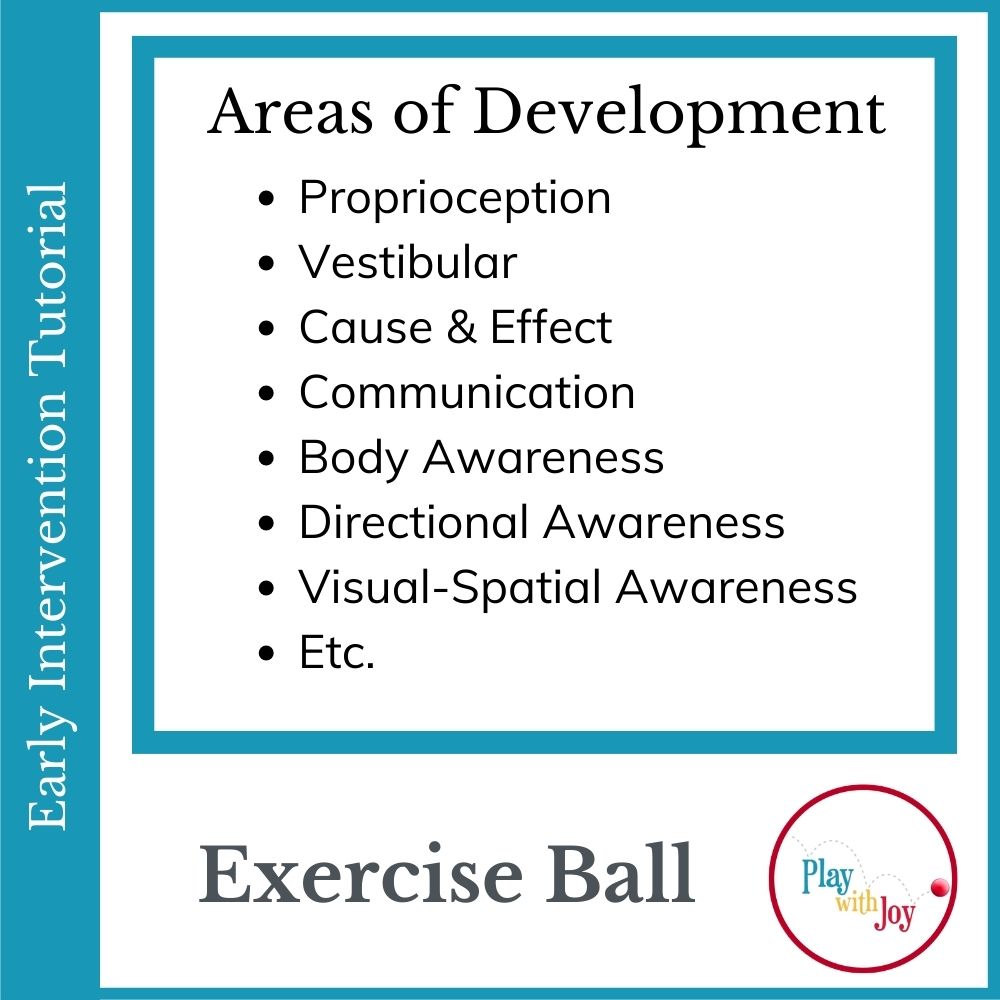
You can use an exercise ball to address different areas of development. I’ll get more specific in the sections below.
The great thing about having an activity that has so many different ways to play, is you can use that to increase engagement, creativity, and fun.
Make a list of all the things you can do with an exercise ball before you start to play so that you don’t have to figure it out in the moment. (This is called Theme and Variation)
Let your child decide how you’re going to play with the ball, and follow his lead.
Video Tutorial
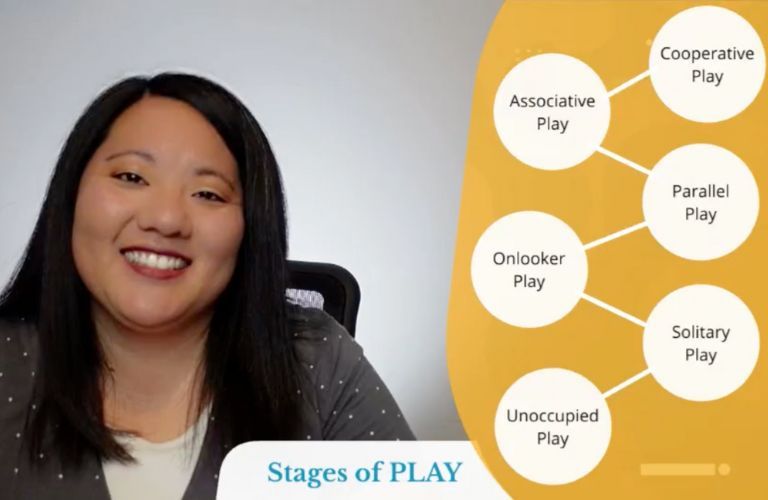
Adapting to Different Stages of Play
Stages 1-4
Our goals here at this level are to get more communication and back and forth interactions. We’re going for lots and lots of circles!
Create a routine/sequence to get your child used to the activity. Then as your child is engaged and loving the activity, give long pauses and wait expectantly for your child to initiate that he wants more.
Once you’ve done this activity for a while, start to add some theme and variation. Think of different ways you can do the activity.
Let’s say you’ve been bouncing on the ball and rocking on the ball. If your child is really engaged, see if she will let you know which one to do. It doesn’t matter if it’s verbally or through some kind of gesture.
The gesture might be that your child tries to bounce or rock on her own. Then label it and do it.
For example, your child is having fun, you’re seeing lots of smiles and giggles. Then you say “stop” and then you just look at your child expectantly, maybe shrugging your shoulders a little. Don’t give any prompts at this point, just wait. Your child starts to bounce on her own, so you say “BOUNCE!” and then you bounce her. (salient language)
This is a great way to help your child open more circles (initiate).
Stages 4-6
When you’re getting lots of continuous circles of communication and your child is participating in pretend play and cooperative play, think about adding some imagination to the activity or academic skills to your activity.
Here are some examples of things you can do for pretend play. I’ll give examples of academic skills in the cognitive section below.
Have a stuffed animal that bounces on the ball.
Pretend your child is on a boat going on an adventure.
Pretend that the big boulders are coming after your child, and have your child run from the “boulder.”
You can also play more organized games to get some cooperative play in.
Play soccer with the big ball
Add the ball to an obstacle course
Take turns doing tricks on the ball
Count as high as you can as you bounce on the ball, alternating who says the number
Developmental Skills
In this section, I will give you specific examples of what you can do in this activity to address specific areas of development.
Communication
Receptive Language
Receptive Language (Understanding language)
For kids that are not yet speaking, or have a limited vocabulary, use this activity to get more engagement and increase circles of communication.
Use salient language, emphasizing one or two words. For example instead of saying “That was a lot of fun, should we bounce again?” You can just say “BOUNCE?” or “Do you want to BOUNCE?”
After building up a routine, start to build another routine so that you a give choices. For example, do a 1-2-3 Bounce, but then do a 1-2-3 Rock. Then once the child is familiar with both, let them choose. Oftentimes kids that are not yet speaking might just move their body to indicate if they want to bounce or rock.
Sing row, row, row your boat, but then add different verses like sway your boat, bounce your boat, wiggle your boat, etc. Then before you start singing, wait expectantly for the child to indicate which verse they want you to sing. Here is a version of the song I like to sing.
Expressive Language
Expressive Language (Using words, gestures, or writing to express oneself)
For kids who are able to say many words, you can add more variety into the activity by asking what they want do. For example,
Do you want to go fast or slow?
How many times do you want to bounce?
Do you want to bounce like a bunny, or row like a boat?
Should we sing row your boat or ABCs?
Remember not to make the activity into a quiz. When you start asking too many questions, you might lose engagement, and spontaneous language. I usually say, ask questions that you don’t know the answers to and be purposeful in your questions.
Two-Way Communication
For kids who have more conversational skills, you can talk more about what you’re doing and add a lot of pretend.
What should we pretend the ball is, should it be our car or an airplane?
Where are we going to go?
Let’s be pirates, who do you want to be?
Cognitive
Cause & Effect
Work on cause and effect by helping your child learn that his words/actions mean something. When your child says “go” you bounce
Build towers and knock them down with the ball
Have the child throw or kick the ball at you and fall down dramatically, be silly
Find different places to roll the ball. Down the stairs, in the kitchen, on the grass, down a hill, up a hill
Play catch with the ball
Pre-Math Skills
You can do all kinds of academic activities with a ball. Instead of sitting at a table and a desk, make it interactive. Using a ball can increase attention and engagement by increasing proprioception and vestibular input.
Do a puzzle on the floor while laying on a ball
Color sorting-put a bunch of colored objects on the floor, have your child pick up an object every time you rock her to reach one. Then have her put it in a matching colored bowl
Do a file folder game
Count how many balls he can reach and put in a basket
Put big pieces of colored paper on the walls and have your child stand in the middle of the room with the ball. Say a color and your child tries to roll the ball to the colored paper
You can also do this with some pre-literacy skills such as putting uppercase letters on one side and lowercase on the other side, and have her match them
Motor Skills
Gross Motor Skills
Gross Motor (skills that involve the large muscles of the body)
Push the ball back and forth to each other
Bounce the ball to each other
Catch the ball
Play soccer with the ball
Play basketball with the ball and a large laundry bin or garbage can
Have the child lay on her stomach on the ball, and push off the floor to rock back (with your help of course)
Do simon says with the ball, and have the child do large motor actions such as “lift the ball above your head”
Fine Motor Skills
Fine Motor (skills that involve the small muscles of the body)
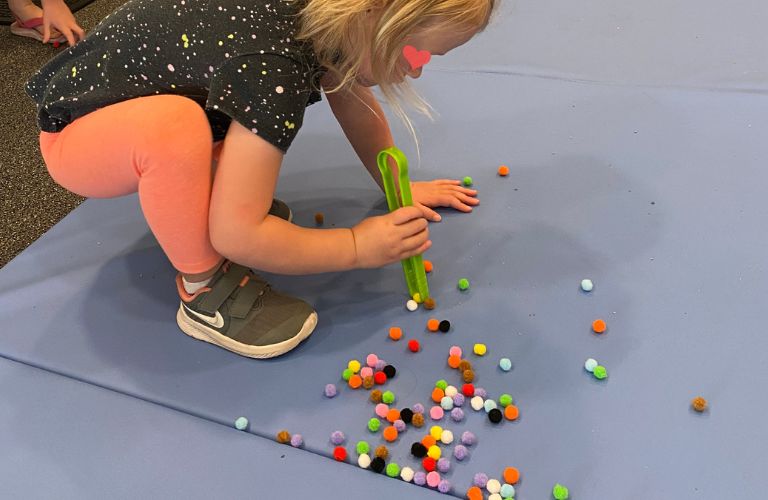
Put cotton balls on the ground and have your child pick them up with tweezers (see link section for examples) and put them in a bowl. Do this while laying on his stomach on a ball. You rock him to reach them.
Have the child do a puzzle while laying on his stomach on the ball with the puzzle on the floor
Pick up coins off the ground and then put them in a piggy bank
Push the ball to each other only using fingertips instead of the palms of the hand (work on hand strength)
You can really do any fine motor skills that you would do sitting in a chair while laying on a ball. Being on the ball activates different muscles, and also is engaging for kids. So although the actual ball may not be a fine motor skill, you can work on fine motor skills while on the ball.
Perceptual Motor Skills
Perceptual Motor (coordinating senses and motor skills to interact with the environment)
–Body Awareness (knowing body parts and where they are in a defined space)
Play a game of Simon Says. Do different actions like sit on the ball, stand behind the ball, lift the ball above your head, lay under the ball, put your head on the ball, put your back on the ball, etc.
–Crossing Midline (moving one limb across midline to the other side of the body)
Put puzzle pieces on the left, and the puzzle board on the right. Have your child use the same hand to pick up the piece and put it in the right place
When you’re bouncing on the ball talk about going up/down, left/right. Roll the ball in front/back. Get on top/bottom of the ball.
–Eye-hand Coordination
Play catch with the ball
Knock things over with the ball
Try to hit a target with the ball
–Motor Planning (being able to perform a sequence of movements to complete a task)
Stack up some blocks and the knock them down by rolling the ball over them
–Visual-Spatial Perception (being able to tell where objects are in a defined space)
Play with a shape sorter while on the ball
Put several different objects within reaching distance and name an object for the child to retrieve when they’re rolling on the ball
Social Skills
Social-Emotional
Social skills
Turn taking
Sharing
Cooperative play with playing catch or playing a game like soccer
Pretend play-pretend the ball is a car, boat, or rocket ship. Pretend to be in a circus and do tricks with the ball, pretend the ball is a big boulder and you’re hitting all the monsters
Behavior
Playing with a ball can give a lot of great vestibular and proprioceptive input. This in turn can help a child feel more organized in her body, and can sometimes help with behavior.
Every child’s sensory system is different though, and some are seekers while others are avoiders. Be sensitive to the child’s needs and wants.
Combining bouncing on the ball with music can be a great coping tool for some kids to help them feel safe and connected
Sometimes as adults, we view bouncing on an exercise ball as a “fun reward,” so we hesitate to let kids use it—especially when they need it most as a coping or regulation tool. Try reframing the situation: Our goal is to help children learn to regulate their bodies using effective tools. If we withhold those tools just because the activity feels rewarding or enjoyable, we’re also removing something that genuinely helps them feel calm, focused, and in control.
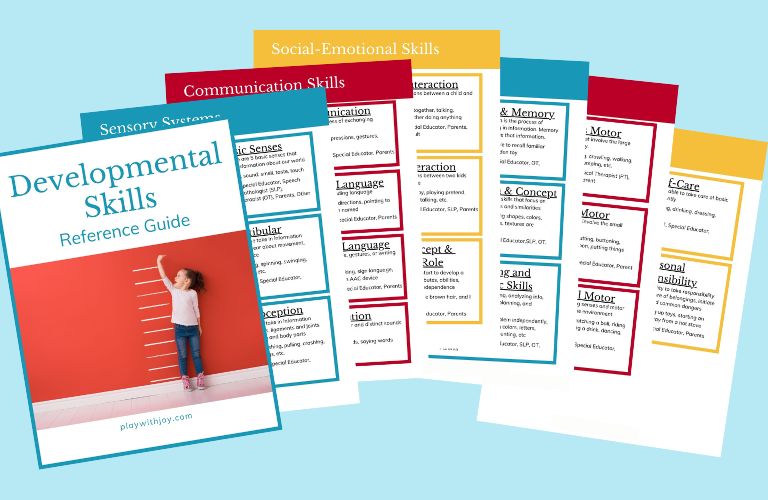
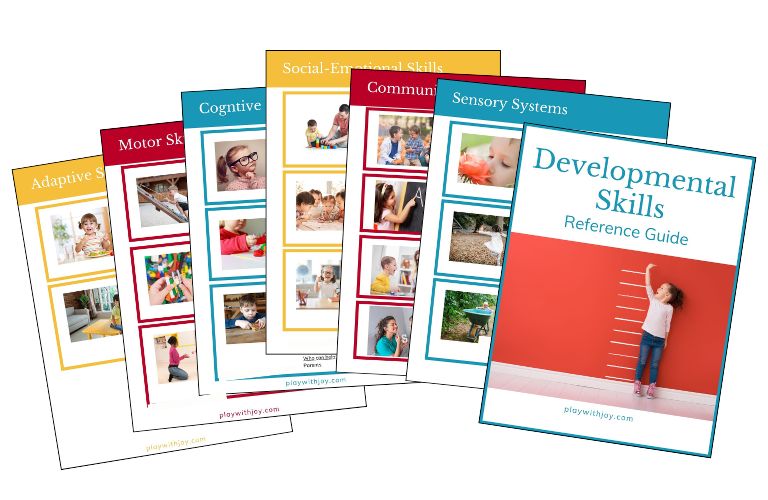
Get Your Free Developmental Skills Reference Guide
Parents, educators, and therapists – Add this to your toolbox to better understand key areas of child development. Plus get extra tips, activities and strategies to your inbox.
Unsubscribe at any time. See Privacy Policy for more details.