How Swinging In A Blanket Can Help Increase Communication
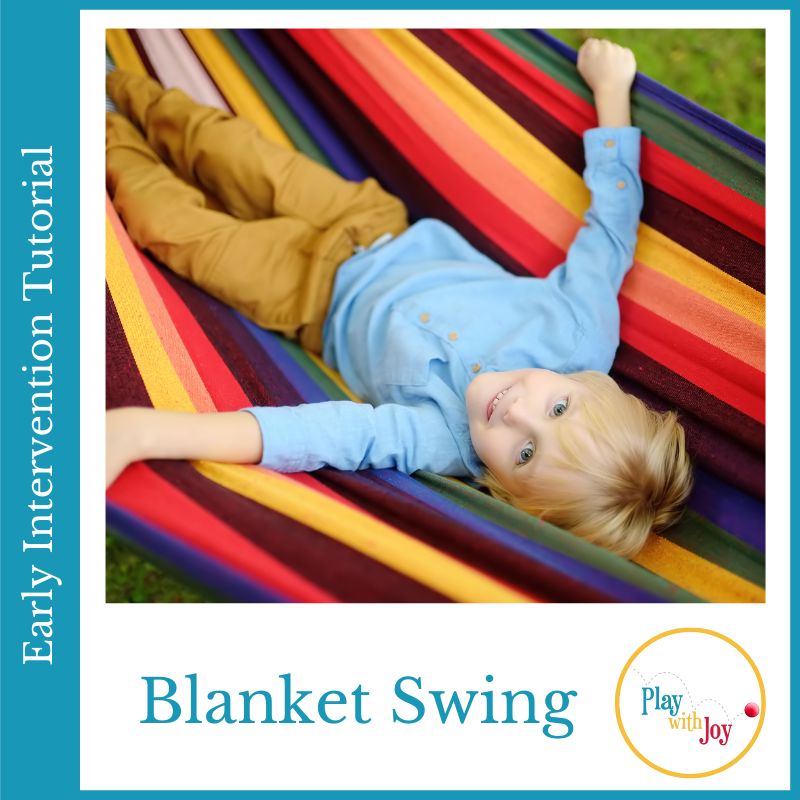
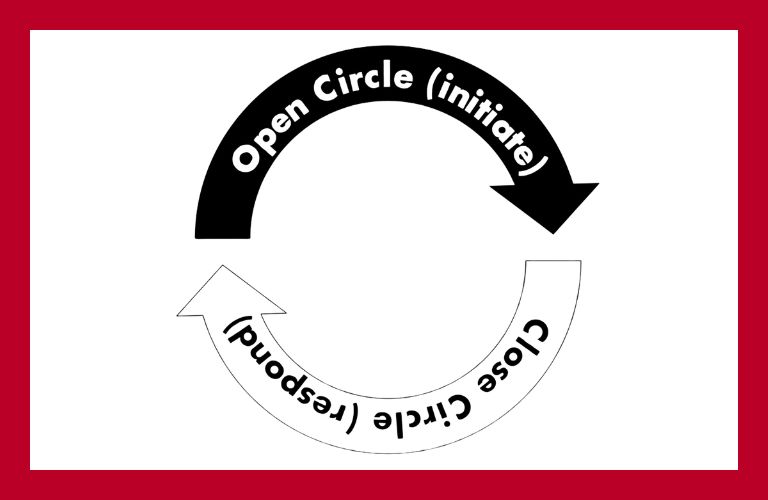
I know I say this about a lot of activities, but swinging in a blanket is one of my favorites for a neurodivergent child that is working on communication, particularly initiating (opening circles).
Here are just a few reasons why I love this activity:
It’s fun
It’s engaging
It’s motivating
It involves several sensory systems at once
There’s so many things you can do to the activity to change it up and keep it going
Most people own a blanket, so you don’t need to go out and get supplies
You can use this activity for all stages of play
Today I’m going to talk mostly about working with kids who are working on increasing the number of consecutive circles they have during each interaction.
As a disclaimer, remember that every child is different, and some kids don’t like the movement of being in a blanket swing. If this is the case, read the child’s cues and find a different activity.
Typically, I teach the importance of following the child’s lead, but there are occasions when the child is not going to come up with an idea like swinging in a blanket unless they’ve done it before. So, obviously you may need to introduce this activity to the child. However, once you introduce it, and the child begins to initiate doing more, it then turns into their idea. If they reject your idea, then try again another time.
Start by creating a routine and having fun, and once the child is engaged, you can start changing things up. Your routine could be as simple as this:
Lay the blanket on the floor
Have the child lay on the blanket
Pick the blanket up
Say something like “1,2,3, GO!”
Swing
Stop
Do this several times until you know the child wants more. Then start having long pauses. Wait expectantly for the child to initiate (open a circle) that he wants more. Remember, gestures are communication. We’re going for engagement and circles. I wouldn’t recommend saying things like “say more, say more.” You can model it and give him action words, but don’t force him to say it.
So, if the child just looks at you and smiles, you can take that as communication and say “swing!” and then start swinging.
When the child is completely engaged and wants more and more, take advantage of this time and create opportunities for the child to communicate those wants.
Change things up a little, get creative. You could fall asleep so the child has to initiate things like
waking you up
putting the blanket in your hand
initiating for you to lift the blanket up
initiating for you to swing her
Know what the child’s limits are, you don’t want to make it so hard he gives up, but you also don’t want to do too much that you’re not giving those opportunities of communication.
The Functional Developmental Levels (FDL) are based on The PLAY Project and DIR/Floortime
FDL 1: Self Regulation & Shared Attention
FDL 2: Engagement & Relating
FDL 3: Intentionality & Two-Way Communication
FDL 4: Social Problem-Solving & Mood Regulation
FDL 5: Creating Symbols & Using Words & Ideas
FDL 6: Emotional Thinking, Logic & Sense of Reality
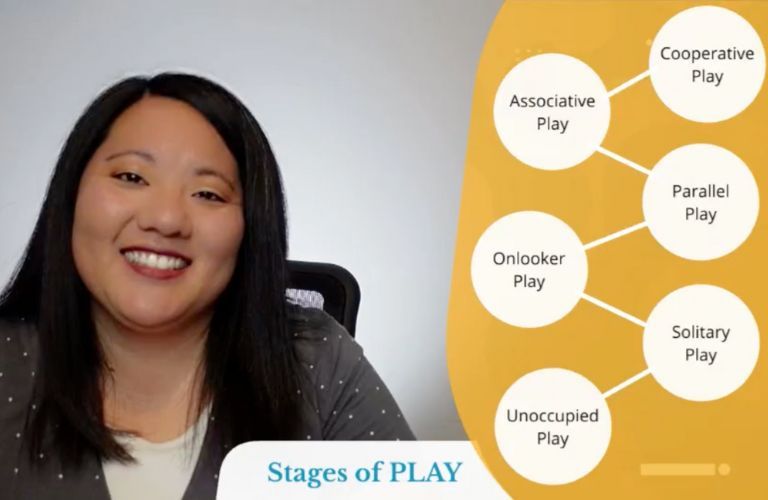
Stages of Play: 1-6
This activity is great for kids primarily participating in stages: 1-6
The Stages of Play come from Parten’s Stages of Social Play.
Stage 1: Unoccupied Play
Stage 2: Solitary Play
Stage 3: Onlooker Play
Stage 4: Parallel Play
Stage 5: Associative Play
Stage 6: Cooperative Play
Sensory Input: Vestibular, Proprioception
This activity includes: vestibular and proprioception
Our senses include more than the usual 5 senses. Some kids may seek certain types of sensory input and/or avoid other types.
Visual: Sight
Auditory: Sound
Olfactory: Smell
Oral: Taste (Gustatory) and using the mouth to speak, make sounds, eat, chew, drink, etc.
Tactile: Touch
Vestibular: How we process information about movement, gravity, and balance. We receive this information through the inner ear.
Proprioceptive: How we process information about body position and body parts. We receive this information through our muscles, ligaments, and joints.
Areas of Development: Communication, Cognitive, Executive Functioning, Motor, Social
This activity is good for targeting the following developmental skills: communication, cognitive, executive functioning, motor, social
These are the main areas of child development addressed in the Early Intervention Tutorials
Communication: receptive language, expressive language, listening, two-way communication
Cognitive skills: cause & effect, literacy, math, science, problem solving, perception and concept
Executive functioning: emotional control, flexibility, perseverance, self-monitoring, organization, planning, response inhibition, attention, task initiation, time management, working memory
Motor skills: fine motor, gross motor, perceptual motor
Social-emotional skills: peer interaction, self concept & social role, pretend play, behavior, group activities
Adaptive skills: self-care, personal responsibility
Supplies
Blanket
Pillow or couch cushion
Instructions
This activity requires two adults
Lay some pillows, a couch cushion, or a pad on the ground where you are swinging
Have the child lay in the blanket
Hold the corners of the blanket, and swing the child
Extra Tips & Ideas
Extra Tips & Ideas
Please read your child’s cues. This activity can help some kids get regulated, but it can also be dysregulating for other kids. Also, too much of any kind of movement can also be dysregulating, so it’s important to allow your child to stop when he is ready to stop.
Add rhythm and music while you swing. This can be done with songs, counting, or even ready, set, go routines
I’ll give you more examples of how to make this activity engaging, and increase communication at the different stages of play in the next section
Video Tutorial
Adapting to Different Stages of Play
Stages 1-4
Our main focus at stages 1-4 is going to be attention, engagement, and simple circles of communication (even if it’s just 1-3 circles at a time). Swinging in a blanket can target all of those areas.
You can use this activity to target goals similar to these.
GOALS:
Increase attention to one activity
Engage in play with a familiar adult
Initiate wants and needs through words, sounds, gestures, or facial expressions (open circles of communication)
Increase natural imitation
Participate in purposeful interactions
TIPS FOR PLAYING WITH A CHILD AT STAGES 1-4
If you’re having a difficult time getting your child to engage with you, it’s ok to just sit near your child and be with each other
Sensory motor play can be a powerful tool to help increase and maintain engagement, that’s why I love this activity
Our goals at these stages are attention, engagement, and circles of communication. Try playing without giving any directions or asking any questions. Instead, narrate what’s happening.
Stages 5-6
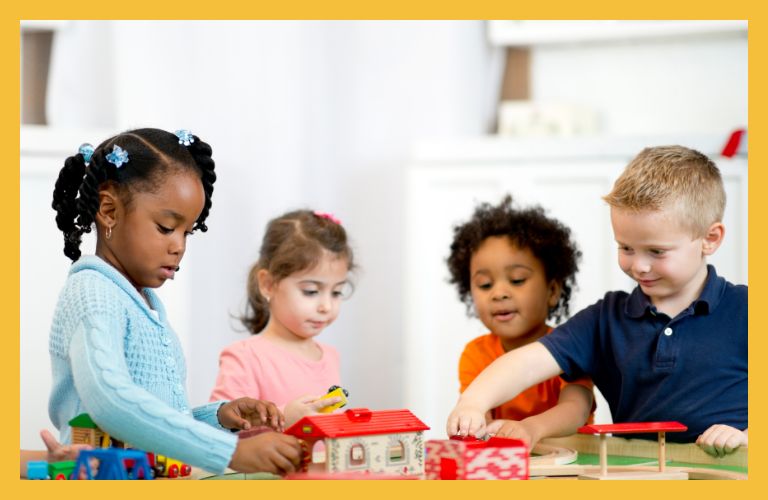
These stages are when kids are starting to interact more with each other, communicate with each other, and negotiate with each other. This is also when kids start to do more complex pretend play.
GOALS:
Imitate pretend play
Follow one-step directions
Follow multi-step directions
Increase time engaged in conversations
Share ideas through conversation
Act as a character in role-play
Create a drama that “make sense” with a beginning, middle, and end
TIPS FOR THESE STAGES
Allow your child to take the lead with the pretend play, but also throw in your ideas. Make it balanced.
Before you start doing this activity, talk about what you want to do, maybe choose roles (Let’s be pirates, or let’s be sailors)
Now is the time when it’s ok to ask questions and give some directions. No one likes being bossed around or quizzed during playtime though, so be careful how often you’re doing it. Be purposeful. Don’t ask questions you know the answers to, ask questions to find out what your child is thinking.
Developmental Skills
In this section, I will give you specific examples of what you can do in this activity to address specific areas of development.
Communication skills
Receptive Language
Receptive Language (Understanding language)
For kids who are not using more than 1-2 word sentences independently, use salient language throughout this activity. This means you’re emphasizing certain words, or just using one word as you speak. For example you might say things like “let’s SWING!” “Swing, swing, swing” “1,2,3 SWING”
You may want to print some pictures for your child to point to or touch as you’re doing this activity. You could have a picture of swinging and one of bouncing. Then give your child a choice of what to do.
Give your child choices. Do you want to go fast or slow? Should we swing or drive (drag the blanket across the room). Offer two different blankets, do you want the red blanket or the blue blanket?
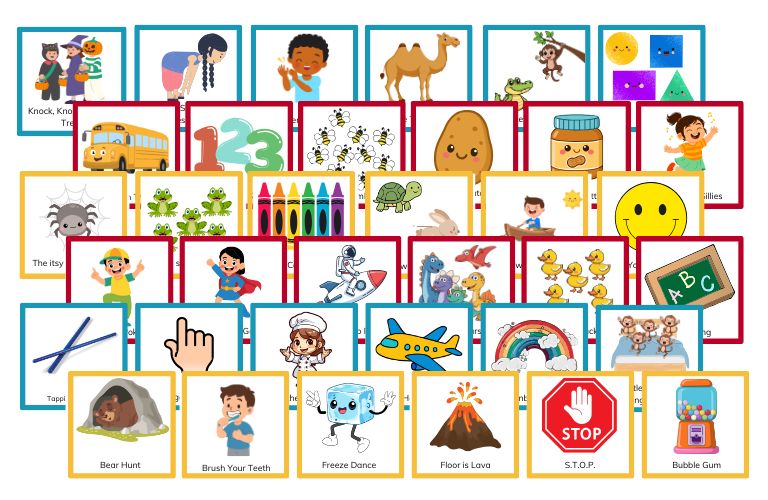
Use rhythm and music by singing different songs like row your boat, abcs (some other examples are in the video)
For kids who are able to follow directions, work on simple one step or multi-step directions. For example, “sit down” “lay down” “scoot over” “sit in the middle” etc. Or for multi-step directions you could say things like “let’s turn the blanket over and then you can sit in the middle” or “go get the red blanket and bring it to me”
Expressive Language
Expressive Language (Using words, gestures, or writing to express oneself)
For kids who are working on initiating, set up the routine or sequence of starting and stopping swinging, maybe add a little “1,2,3 Swing!” in there. After this routine is set up, then pause and wait expectantly for your child to initiate that she wants more. This can be through a word, a gesture, eye contact. Whatever it is, take it as communication (if you’re working on communication, don’t discount your child’s attempt at communicating just because it’s not how you want your child to communicate), give it a word, and start swinging again.
For kids who are able to use more words, expect more when they initiate. If they just say “go”, then do some playful obstruction and do the wrong action, instead of swinging maybe spin in a circle.
For kids who are able to have conversations, start pretending. Pretend to go on a boat ride, ask for a ticket, tell her how much it is, go back and forth with your conversation before starting to swing.
Two-Way Communication
Two-Way Communication (Continuous back and forth interactions)
For kids who are working on initiating, focus on getting multiple circles of communication. Get as many back and forth interactions as you can between swings.
As your child is able to communicate more, and you are getting 20+ back and forth circles, then start working on the quality of circles. First quantity, then quality.
Cognitive skills
Cause & Effect
Work on cause and effect by helping your child learn that his words/actions mean something. When your child says “swing” (or makes some kind of gesture) then the effect is that he gets to swing more.
Perception & Concept
Perception and Concept (Examining differences and similarities)
Swing differently and compare the rides
Fast vs Slow
High vs Low
Bumpy vs Smooth
Side to side vs Back and forth
Shake vs Swing
Problem Solving
For kids who are at stages 1-4, work on social problem solving by throwing in little obstacles to the play.
This increases circles, but also helps them problem solve how to get you to swing them more.
For example:
Set the blanket down so your child has to initiate for you to pick it back up.
Fall asleep so your child has to wake you up first.
Hide under the blanket so your child has to find you
Then later run away and hide turning it into a simple version of hide and seek.
If your child stays engaged and keeps problem solving, keep adding to the sequence
For kids who are at stages 5-6, work problem solving into the pretend play.
Pretend there are pirates stopping your ship, what do you do?
Pretend there are sharks all around you, how do you get them to go away?
Executive Functioning skills
Planning
Planning (Making a plan with at least a few steps and following through)
For kids at Stages 1-4, you can use this activity to work on motor planning. In the Problem Solving section, I talked about creating little obstacles. This creates opportunities for your child to create a plan of how to get you to keep swinging her, and then to work through that plan. This is the beginning stages of planning.
For kids at stages 5-6, you can help your child plan how you’re going to play before you start playing. Then help your child remember that plan as you go. Obviously, you want to be flexible and allow your child to come up with new ideas throughout the pretend play, but also occasionally talk about the original plan.
Attention
Attention (focusing and taking in information even when there are distractions or if it’s boring)
For kids that have a difficult time maintaining their attention on one activity for extended periods of time, participating in sensory activities like a blanket swing is a great place to start. If you want to help your child increase her attention, you want to start with activities she loves that are naturally motivating.
Motor Skills
Perceptual Motor Skills
Perceptual Motor (coordinating senses and motor skills to interact with the environment)
Body Awareness (knowing body parts and where they are in a defined space)
Activities with proprioceptive input, like being cradled in a blanket are great for body awareness. It helps define the space around the child’s body, and for the child to feel that input.
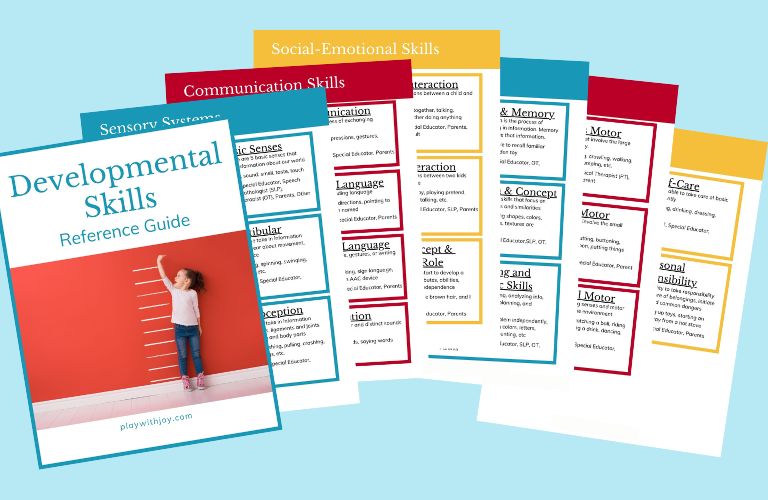
Get Your Free Developmental Skills Reference Guide
Parents, educators, and therapists – Add this to your toolbox to better understand key areas of child development. Plus get extra tips, activities and strategies to your inbox.
Unsubscribe at any time. See Privacy Policy for more details.