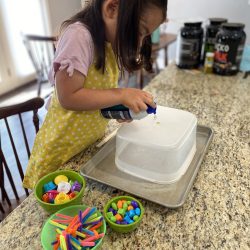
The great thing about early intervention activities are that kids learn best through play and a lot of kids love sensory activities. This is a simple activity, but it can get messy. You’ve been warned.
You can adapt this activity to target specific developmental skills including receptive language, expressive language, pre-literacy skills, math skills, social skills, and motor skills. In this post I will focus primarily on motor skills.
Fine motor skills are when we use our small muscles. Fine motor skills are important because they affect so many parts of our lives. Think about all the things that you do with the small muscles in your hands.
Some kids need extra help strengthening those muscles and so we find ways to strengthen those fine motor skills. So, let’s look at some ways that we can do that with this activity.
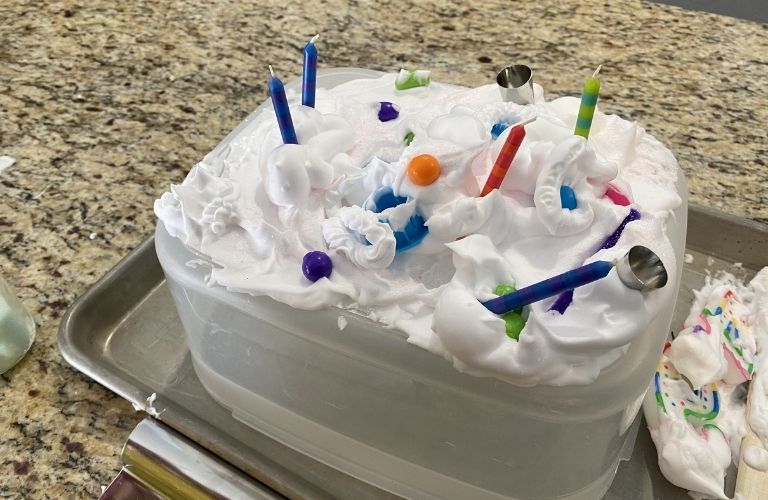
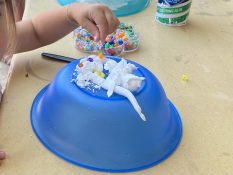
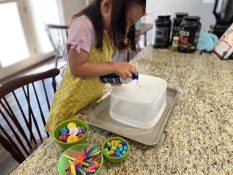
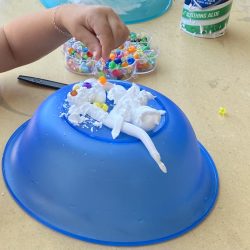
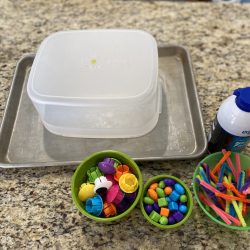
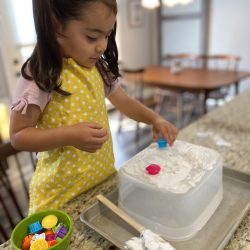
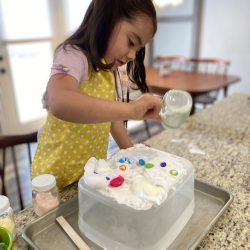
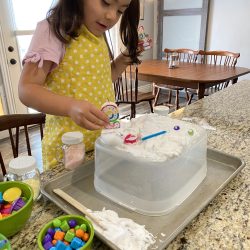
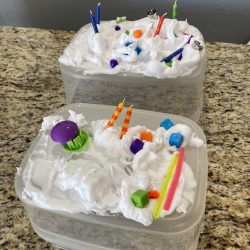
Find small objects to use as decorations such as beads (obviously, be cautious of choking hazards). Just picking up the small pieces and decorating the cake will help work on your child’s pincer grasp as he uses the tips of his fingers.
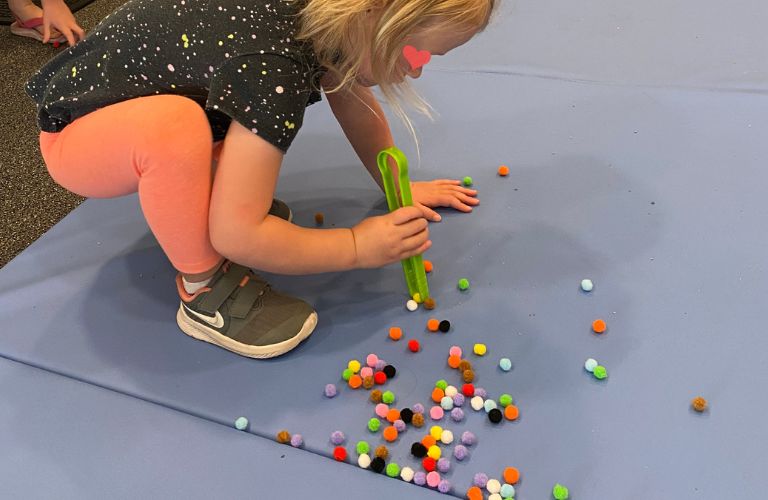
Use tongs or tweezers to pick the items up with. This works on pincer grasp, hand strength, and eye-hand coordination. I put a link at the bottom of the page as an example of what I’m talking about. I use these all the time for different activities. If your child has a hard time picking up hard items like beads, try something soft like a pom pom.
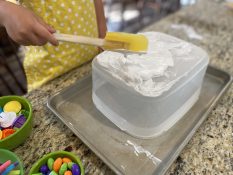
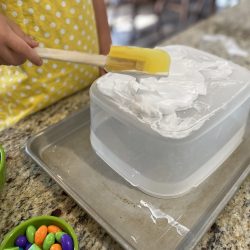
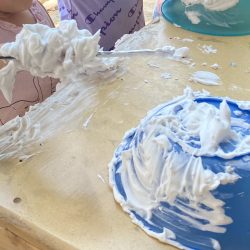
Use a spatula to spread the cream out. Using novel items is fun for kids, especially if it’s something they’ve seen you do.
Have your child hold multiple pieces in one hand and drop them one at time onto the shaving cream cake. This can help with your child’s dexterity.
Use a candle to draw shapes in the shaving cream.
Make holds in the shaving cream and have your child drop beads or put candles in them.
Use piping bags filled with shaving cream. Squeezing the bag will help with hand strength and coordination. If it’s big enough that the child has to use two hands, this will work on bilateral coordination.
Adapting To Your Child's Developmental Level
It’s important to take into account where your child is at developmentally when planning an activity. If your child is not yet following directions or imitating, then you’ll have different goals. You’ll want to work more on attention and engagement, so free play and exploration is going to be more important.
If you have a child that is able to participate in pretend play, you may want to provide an environment for your child to explore in that way. Understanding your child’s development can help you play at the right level. Playing too high or too low is not beneficial and you’ll see less growth. Playing at the right level will help your child progress more.
Shaving Cream Cake Tutorial
Once you purchase the Shaving Cream Cake Tutorial and log in, you will have full access to all the content below this section.
Candles-If you’re working on color identification, using colorful candles could be one way to work on that skill.
Spatulas-Having a variety of tools to use can help make the activity more engaging. Spatulas can be good for spreading the cream around which works on fine motor skills and bilateral coordination (hold the “cake” with one hand and the spatula with the other)
Cake Tips-Using cake tips can be a fun way to work on hand strength, bilateral coordination, crossing midline, and motor planning.
Letters-Use letters to decorate the cake if you’re working on literacy skills.
Animal Counters-Use little figurines to decorate the cake with
Shapes-If you’re working on shape recognition, something like this would be fun to play with when decorating the cakes.
Tweezers-You can use tweezers for a lot of different activities.
Extra Tips & Ideas
Extra Tips & Ideas
Decide what developmental skills you want to target, and that will determine how you set up this activity.
If you are targeting attention, or sensory exploration, then all you have to do is present the activity and let your child explore.
If you are targeting fine motor skills, you’ll want to find items that will help with that (see the developmental skills section if you have purchased this tutorial)
If you are targeting color identification, obviously make sure you have those colors
Video Tutorial
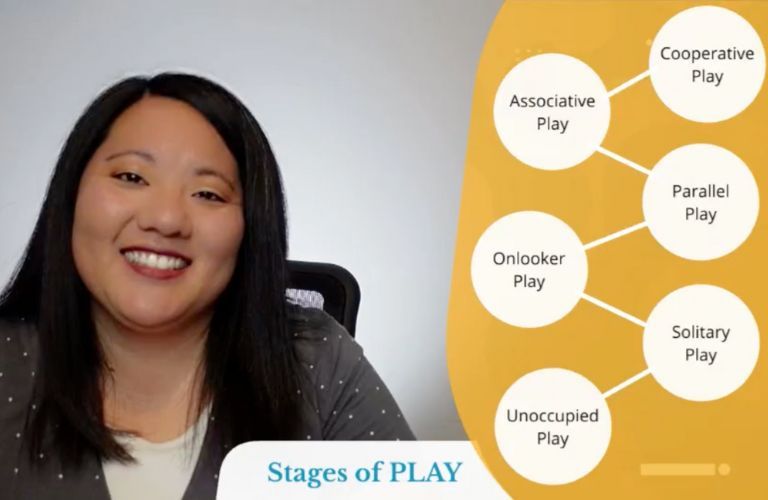
Adapting to Different Stages of Play
Stages 1-4
At stages 1-2 kids may not be very interested in other people yet. At stages 3-4, kids are typically starting to be interested in other kids, but aren’t engaging in play with them yet.
Our main focus at stages 1-4 is going to be attention, engagement, and simple circles of communication (even if it’s just 1-3 circles at a time).
GOALS:
Increase attention to one activity
Engage in play with a familiar adult
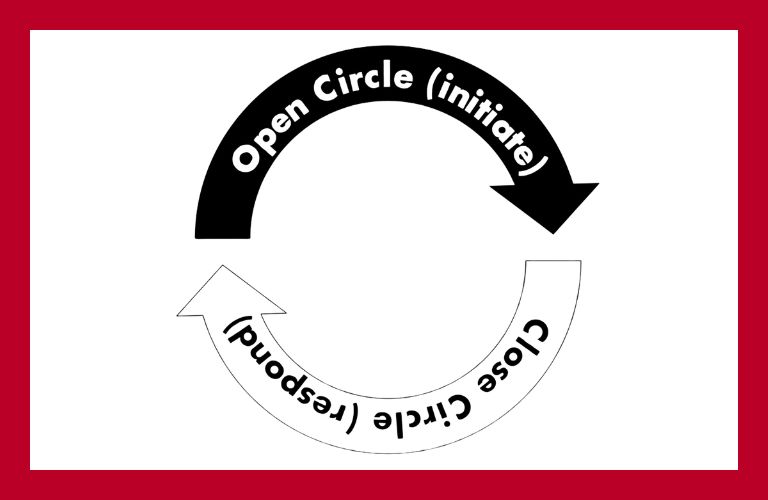
Initiate wants and needs through words, sounds, gestures, or facial expressions (open circles of communication)
Will respond when you open a circle of communication (close circles of communication)
Explore different textures
Increase time participating in parallel play (playing next to a peer with like materials)
Increase natural imitation
TIPS FOR PLAYING WITH A CHILD AT THESE STAGES
If you’re having a difficult time getting your child to engage with you, it’s ok to just sit near your child and be with each other
Instead of trying to get your child to imitate you, try imitating your child. Sometimes this helps pique your child’s interest in you
Our goals at these stages are attention, engagement, and circles of communication. Try playing without giving any directions or asking any questions. Instead, narrate what’s happening.
Focus on finding ways to get your child to open circles. You can use techniques like playful obstruction, expectant waiting, and theme and variation.
If you’re working on sustaining attention to an activity, find high interest items to help motivate your child to maintain playing the activity.
If your child doesn’t enjoy the feel of the shaving cream, this is probably not the best activity.
Stages 5-6
These stages are when kids are starting to interact more with each other, communicate with each other, and negotiate with each other. This is also when kids start to do more complex pretend play.
GOALS:
Imitate motor actions
Imitate pretend play
Follow one-step directions
Follow multi-step directions
Act as a character in role-play
Give a turn to a peer when asked
Ask for a turn
TIPS FOR THESE STAGES
Have individual supplies for each kid, but then have some shared items as well. This will provide opportunities for the kids to share or to talk to each other and ask for an item.
Talk about what each child is doing to help the kids be aware of what each other are doing.
Before you start doing this activity, talk about what you want to do, maybe choose roles (I’ll the baker, and you can be the customer)
Allow your child to take the lead with the pretend play, but also throw in your ideas. Make it balanced.
Now is the time when it’s ok to ask questions and give some directions. No one likes being bossed around or quizzed during playtime though, so be careful how often you’re doing it. Be purposeful. Don’t ask questions you know the answers to, ask questions to find out what your child is thinking.
Developmental Skills
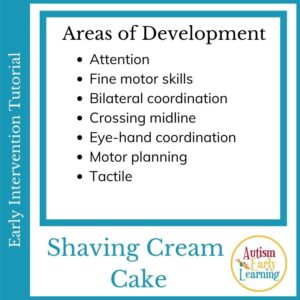
In this section, I will give you specific examples of what you can do in this activity to address specific areas of development.
Communication skills
Receptive Language
Receptive Language (Understanding language)
For kids who are not using more than 1-2 word sentences independently, use salient language throughout this activity. This means you’re emphasizing certain words, or just using one word as you speak. For example you might say things like “1,2,3 Go” as you spray the shaving cream. Or if your child is reaching for a candle, just say “candle.”
Give your child choices. Do you want a red candle or a blue candle? Do you want more shaving cream or beads?
For kids who are able to follow directions, work on simple one step or multi-step directions. For example, “spread the cream out” or “put a candle on” etc. Or for multi-step directions you could say things like “hand me a candle and put a bead on your cake.”
Expressive Language
Expressive Language (Using words, gestures, or writing to express oneself)
For kids who are working on initiating, set up a little sequence or routine when you spray the shaving cream, maybe add a little “1,2,3 Go” in there. After this sequence is set up, then pause and wait expectantly for your child to initiate that he wants more. This can be through a word, a gesture, eye contact. Whatever it is, take it as communication (if you’re working on communication, don’t discount your child’s attempt at communicating just because it’s not how you want your child to communicate), give it a word, and start spraying.
For kids who are able to use more words, expect more when they initiate. If they just say “go”, then do some playful obstruction and do the wrong thing, instead of spraying the shaving cream, shake it.
For kids that are working on expanding their vocabulary, use add a word. Whatever they say, repeat it and add one more word to it. So if your child “more” then you would repeat them and say “want more”
For kids who are able to have conversations, start pretending. Make a cake order and go back and forth with ideas.
Cognitive skills
Pre-Literacy Skills
Work on cause and effect by helping your child learn that his words/actions mean something. When your child says “go” you blow up the balloon or you let it go.
Different ways to incorporate cause and effect.
blowing it up
letting it fly
letting it blow in your child’s hair
kicking it
hitting it
there’s a fun balloon car toy that I put below in the links which is also a great cause and effect activity.
Pre-Math Skills
If you’re working on letter recognition, get some plastic letters to decorate the cake with.
Make recipe cards with symbols for different things like the shaving cream, candles, and other decorations
Your recipe cards could also have different letters to use on the cake for the child to match
Play a game. Print the letter cards (in download section) and take turns drawing cards and then decorating your cake with those letters.
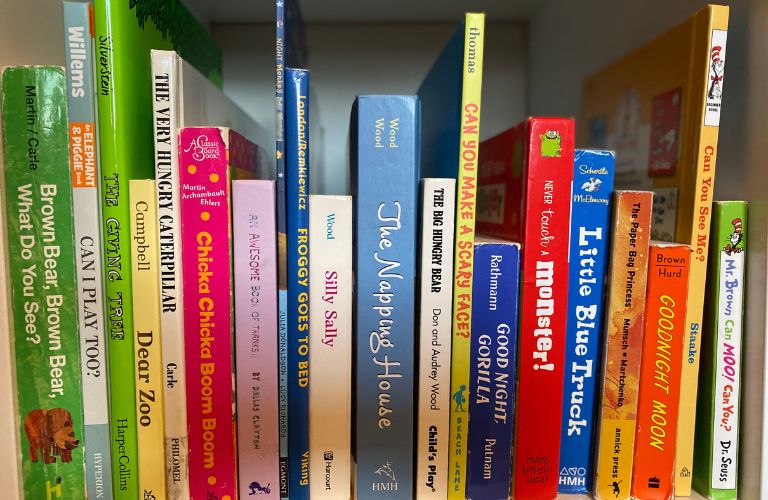
You could read a book about cakes before making cakes together. Then you could act parts of the book out. One good book is called Stir Crack Whisk Bake (the link is at the end of the page). It’s a fun interactive book about making cupcakes.
Motor Skills
Fine Motor Skills
Fine Motor (skills that involve the small muscles of the body)
As your child decorates the cake with small objects, he will be strengthening fine motor skills
Use some tongs or tweezers to pick up items and put them on the cake
Use a spatula to spread the cream out
Have your child hold multiple pieces in one hand and drop them one at a time onto the cake.
Draw shapes in the shaving cream with a candle
Make holes in the shaving cream and have your child drop beads or put candles in them.
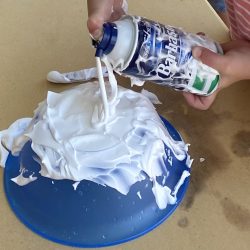
Allow your child to squirt the shaving cream onto the cake.
Perceptual Motor Skills
Perceptual Motor (coordinating senses and motor skills to interact with the environment)
–Bilateral Coordination (using both sides of the body together in one activity)
Fill a piping bag with shaving cream and have your child squirt the shaving cream out of it using two hands.
Help your child steady the “cake” with one hand and spread the cream out with a spatula with the other hand
Let your child spray the shaving cream from the can encouraging him to use both hands
String some beads onto a pipe cleaner for added decorations
–Crossing Midline (moving one limb across midline to the other side of the body)
Place the different items for decoration across the child’s midline so that when he reaches for them, he’s crossing midline
Drop dots of paint on the shaving cream, and have your child match the candles to the paint. For example, have your child hold a blue candle in his right hand, but put a blue dot on the left side of the cake.
When you hand your child something, hand it to him on the opposite side of where he’s going to put it on the cake if you’re able to predict that.
For kids that are able to follow directions, you can play a game where one person is the cake decorator and the other person is the director. Use different directional instructions for the baker. For example, “put two red circles on top of the cake” or “put a blue piece in front of the cake” etc.
Narrate as your child decorates. Talk about where he’s putting all the pieces using words like directional terms.
Social Skills
Social-Emotional
Peer Interaction
For kids working on parallel play, set up everyone’s supplies next to each other. Make comments about what everyone is doing.
Imitate what the kids are doing. “I like how Sammy is putting candles on his cake, I want to do that too.”
For kids that are at stages 5-6, start pretending together.
Make a plan of what you’re doing and what roles everyone is going to play.
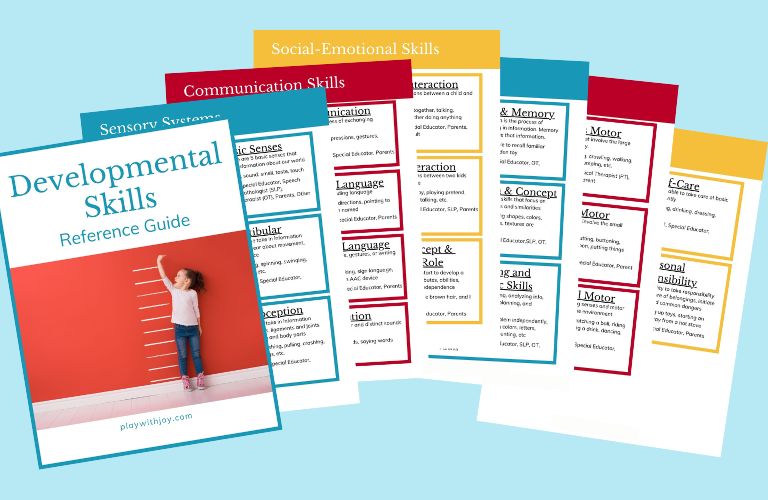
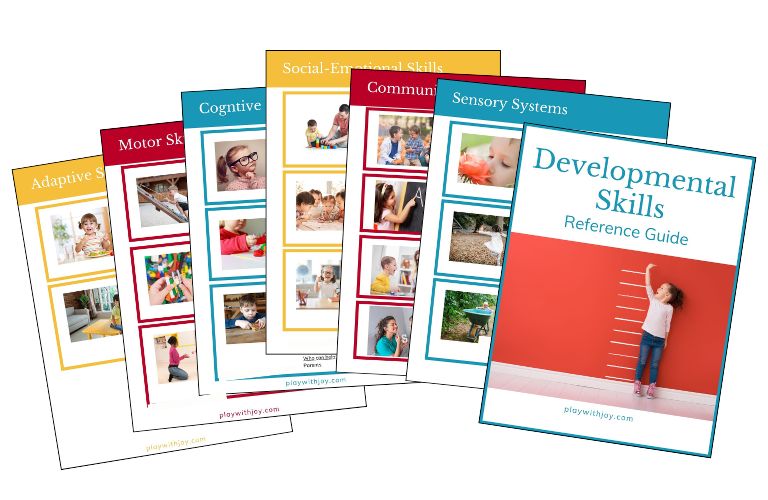
Get Your Free Developmental Skills Reference Guide
Parents, educators, and therapists – Add this to your toolbox to better understand key areas of child development. Plus get extra tips, activities and strategies to your inbox.
Unsubscribe at any time. See Privacy Policy for more details.