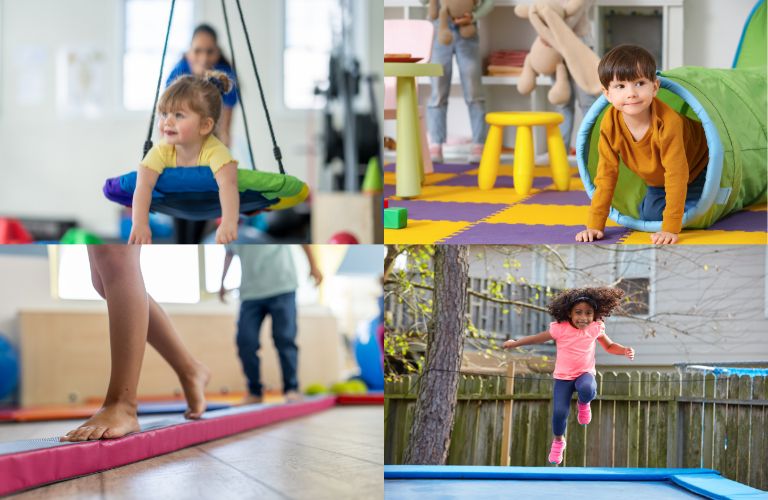
This is one of my favorite early intervention activities because it supports so many areas of child development all at once. It can help build language skills, cognitive skills, executive functioning, social skills, and motor development. In this post, I’m going to focus on perceptual motor skills, but I also want you to know how easily this simple activity can be adapted to support many other developmental skills through play.
Perceptual Motor Skills
Perceptual motor skills are how we coordinate our senses and motor skills to interact with the environment.
There are different areas of development within perceptual motor skills. The ones I’m going to focus on are
bilateral coordination (using both sides of the body together in one activity)
body awareness (knowing body parts and where they are in a defined space)
motor planning (being able to perform a sequence of movements to complete a task.)
Bilateral Coordination
You may find that you will naturally incorporate bilateral coordination into this activity. If you’re wanting to intentionally focus on bilateral coordination, then you can think about the different movements that involve both sides of the body and then get creative in what animal might do an action like that. Your kids won’t even know that’s what you’re working on.
Here are some examples:
Leap like a frog on a lily pad (crouch down to the ground an leap from pillow to pillow)
Talk about your body as you do this activity to bring greater body awareness. Make comparisons, for example, a dog has 4 legs, how many legs do you have? Asking questions and having a conversation will be for kids at FDLs 4-6. For kids that are not engaging in a lot of back and forth interactions, just label and model the language for them.
To bring more body awareness, when you give an instruction, focus on a specific body part. Here are some examples:
Kick your leg like a horse
Thump your chest like a gorilla
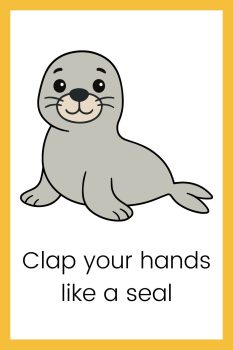
Clap your hands like a seal
Motor Planning
Motor planning is just a natural part of this activity as your child decides how he thinks each animal would move and then coordinating his body to move in that way.
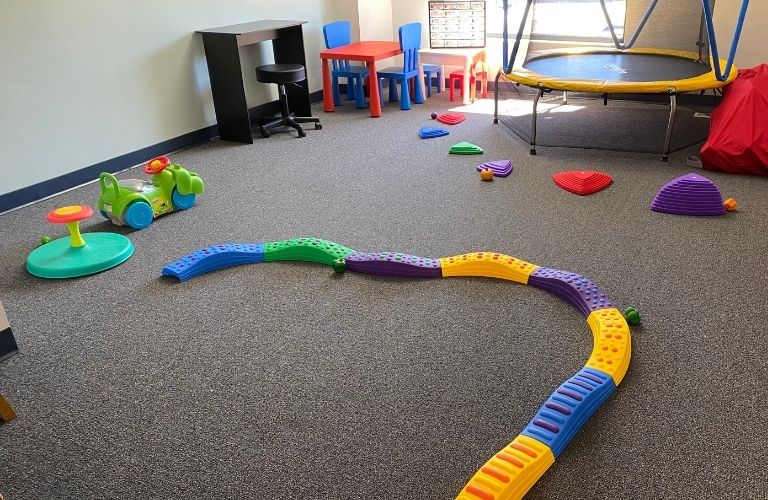
If you want an extra activity that will help with motor planning, you can create an obstacle course. Throughout the obstacle course you can add animal actions into it. Here are some examples:
Climb up the stairs like a mountain goat
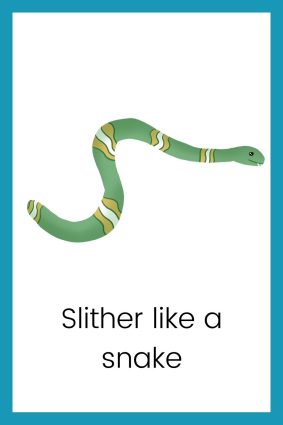
Slither across the kitchen like a snake in the desert
Burrow through a pile of pillows like a rabbit
I hope you’ll get creative and have fun with this activity. You can make it as simple or elaborate as you want! The best thing is that you can change it up as much as you and your child want to while working on so many different developmental skills.
The Functional Developmental Levels (FDL) are based on The PLAY Project and DIR/Floortime
FDL 1: Self Regulation & Shared Attention
FDL 2: Engagement & Relating
FDL 3: Intentionality & Two-Way Communication
FDL 4: Social Problem-Solving & Mood Regulation
FDL 5: Creating Symbols & Using Words & Ideas
FDL 6: Emotional Thinking, Logic & Sense of Reality
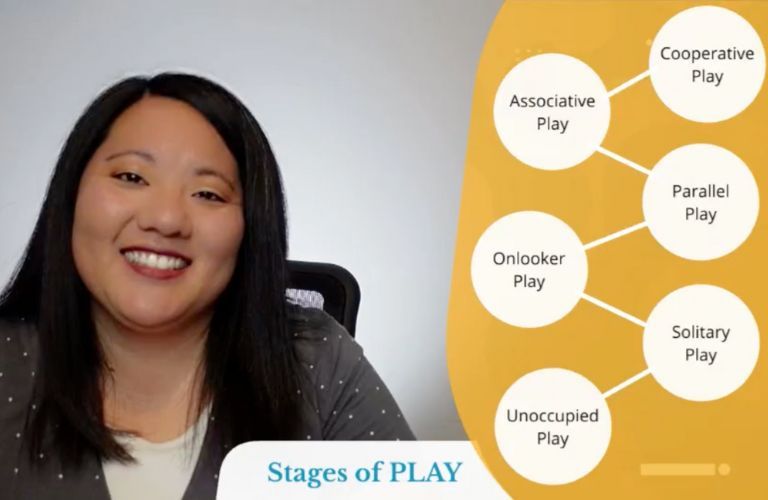
Stages of Play: 1-6
This activity is great for kids primarily participating in stages: 1-6
The Stages of Play come from Parten’s Stages of Social Play.
Stage 1: Unoccupied Play
Stage 2: Solitary Play
Stage 3: Onlooker Play
Stage 4: Parallel Play
Stage 5: Associative Play
Stage 6: Cooperative Play
Sensory Input: Vestibular, Proprioception
This activity includes: vestibular and proprioception
Our senses include more than the usual 5 senses. Some kids may seek certain types of sensory input and/or avoid other types.
Visual: Sight
Auditory: Sound
Olfactory: Smell
Oral: Taste (Gustatory) and using the mouth to speak, make sounds, eat, chew, drink, etc.
Tactile: Touch
Vestibular: How we process information about movement, gravity, and balance. We receive this information through the inner ear.
Proprioceptive: How we process information about body position and body parts. We receive this information through our muscles, ligaments, and joints.
Areas of Development: Communication, Cognitive, Executive Functioning, Motor, Social
This activity is good for targeting the following developmental skills: communication, cognitive, executive functioning, motor, social
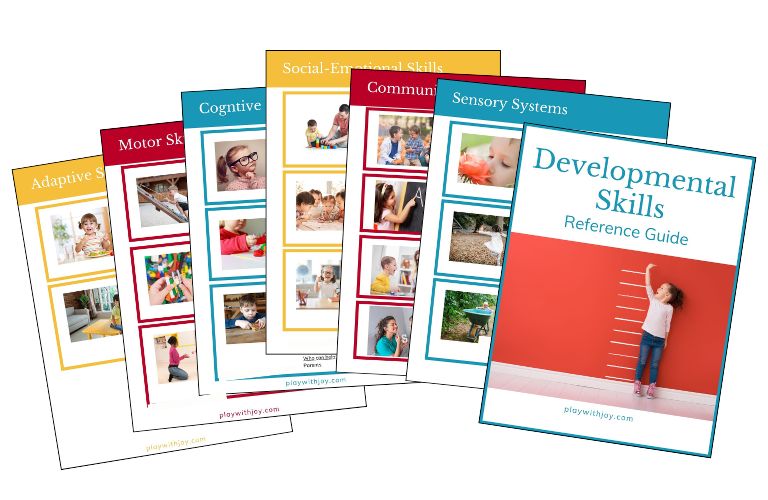
These are the main areas of child development addressed in the Early Intervention Tutorials
Communication: receptive language, expressive language, listening, two-way communication
Cognitive skills: cause & effect, literacy, math, science, problem solving, perception and concept
Executive functioning: emotional control, flexibility, perseverance, self-monitoring, organization, planning, response inhibition, attention, task initiation, time management, working memory
Motor skills: fine motor, gross motor, perceptual motor
Social-emotional skills: peer interaction, self concept & social role, pretend play, behavior, group activities
Adaptive skills: self-care, personal responsibility
Supplies
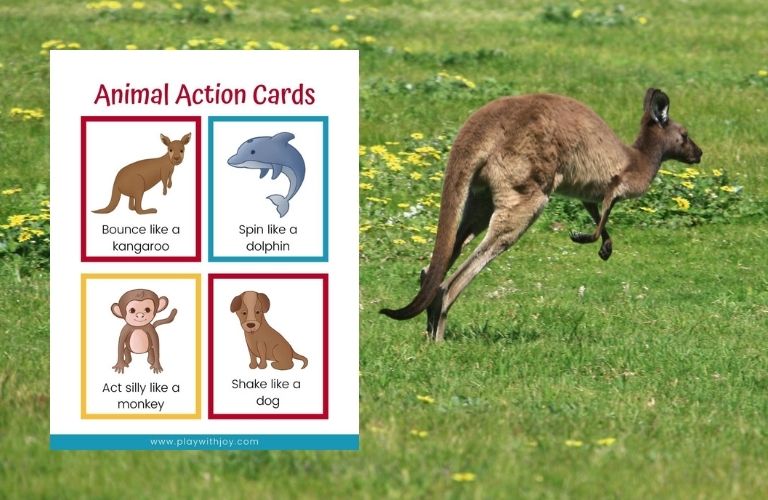
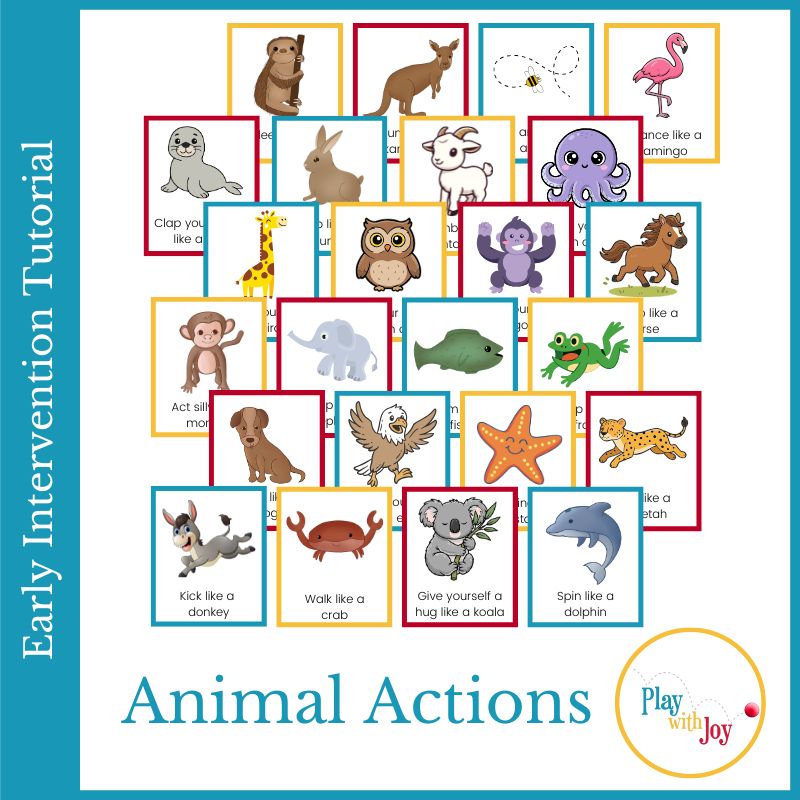
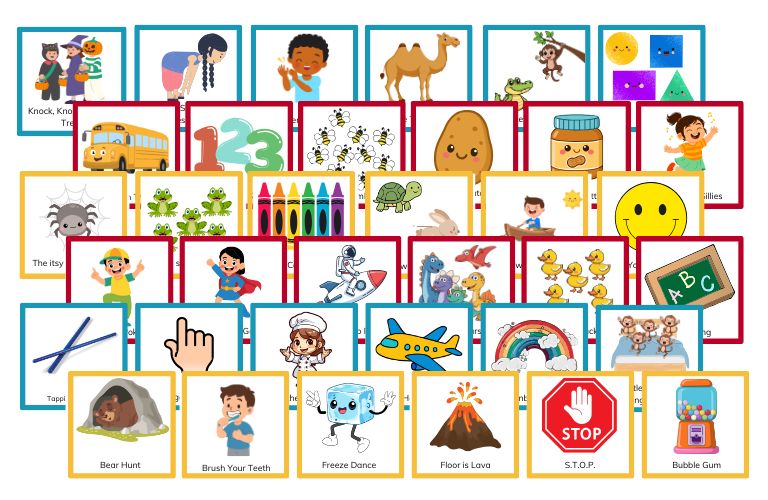
Animal Action Cards
Instructions
Print the Animal Action Cards
Cut out the cards
Laminate (optional)
Take turns picking a card and acting out the different animal actions
Extra Tips & Ideas
Practice counting by doing each action 10 times
Use the cards for a game of charades
Spread the cards all around the room. Act out one of the cards and have your child run and find the matching card. Act it out together
Print two copies of the cards and play a game of memory. When you find a match, you have to act out the card
Add the cards to an obstacle course
Get a wooden puzzle, put the board on one side of the room and the pieces on the other side of the room. Have the child act out one of the animal action cards as he goes to get one puzzle piece. Repeat.
Play Stop and Go. Stand at the opposite side of the room (or yard) as your child. Have him move towards you acting out the card as you say stop and go.
At stages 1-2 kids may not be very interested in other people yet. At stages 3-4, kids are typically starting to be interested in other kids, but aren’t engaging in play with them yet.
Our main focus at stages 1-4 is going to be attention, engagement, and simple circles of communication (even if it’s just 1-3 circles at a time).
This activity is good for
GOALS:
Increase attention to one activity
Engage in play with a familiar adult
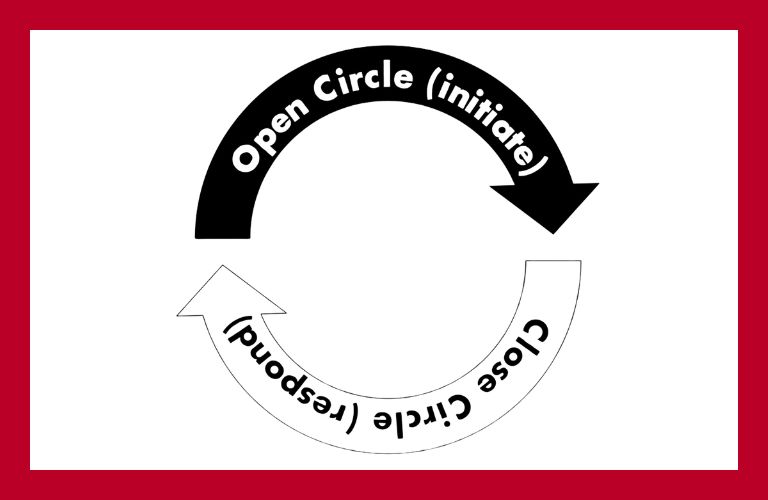
Will respond when you open a circle of communication (close circles of communication)
Participate in cause and effect activities
Increase natural imitation
Participate in purposeful interactions
TIPS FOR PLAYING WITH A CHILD AT THESE STAGES
Instead of playing a game with rules, at this stage you want to just explore the different sounds or actions the animals do
Use the pictures to connect your actions to a word. “I see a cow. Mooo! I’m eating grass like a cow.”
At these stages, we’re going for attention and engagement, be silly and have fun
If your child isn’t ready for following directions, don’t give directions at this point. Model how to do the animal action and make it look like so much fun that your child wants to join in
Label and narrate what your child is doing. If your child starts jumping, label it by saying something like “you’re hopping like a kangaroo! I want to hop like a kangaroo.” And show the picture.
Add some theme and variation to the activity by adding animal toys, playing chase like animals, jumping on the bed like monkeys, bouncing from pillow to pillow like frogs, etc.
Stages 5-6
These stages are when kids are starting to interact more with each other, communicate with each other, and negotiate with each other. This is also when kids start to do more complex pretend play.
GOALS:
Imitate motor actions
Imitate pretend play
Follow one-step directions
Follow multi-step direction
Share ideas through conversation
Act as a character in role-play
Give a turn to a peer when asked
Ask for a turn
TIPS FOR THESE STAGES
At these stages kids are starting to be able to take turns. Take turns drawing a card and then acting out the card.
Play a stop and go game as a group. When you say go, everyone does the action all throughout the room. When you say stop, everyone freezes. This will help with following directions in a group, and also following directions from a distance.
Add pretend into it. Everyone can draw a card and act like the animal on the card. You can make up a whole scenario with the different characters.
Play charades with the cards
Do an obstacle course and give several instructions at a time to work on multi-step directions. For example “jump like a frog across the pillows, then spin like a dolphin on the blue mat”
Don’t get stuck on rules. If your child has some creative ideas, take the time to have a conversation and make up a new game.
Developmental Skills
In this section, I will give you specific examples of what you can do in this activity to address specific areas of development.
Communication Skills
Receptive Language
Receptive Language (Understanding language)
For kids who are not using more than 1-2 word sentences independently, use salient language throughout this activity. This means you’re emphasizing certain words, or just using one word as you speak. For example you might say things like “jump, jump, JUMP!”
Use rhythm and music as you act out the actions. Make up your own songs. I like to use the tune to The Farmer in the Dell a lot. “We’re jumping up and down, we’re jumping up and down, look at Susie, she’s jumping up and down.”
You can use the pictures to choose which action to do next. Put out just 2-3 pictures and touch the one you’re going to do before doing it. Then when your child touches one of the pictures, immediately do that action.
Put 3-4 pictures on the floor face up, and act like one of the animals to see if your child can identify which animal you are being. Then act it out together
Spread the pictures out or put them on the walls and when you say one of the animals, they can do the action as they find the correct picture
Play a game of memory with the pictures, just print more than one copy
Turn the cards into a game of Hullabaloo. This is one of my favorite games, unfortunately they don’t sell it any more. Whoever is calling the instructions will say things like “sit on a big animal” “run to a quiet animal” “spin to a furry animal” etc.
Expressive Language
Expressive Language (Using words, gestures, or writing to express oneself)
For kids that are in the beginning of stages of naming things, use expectant waiting for them to initiate what to do next
When you draw a card, before you ask any questions, wait to see if your child tells you what they got
When you’re ready to do the action, do a “ready, set, go” sequence and wait for your child to say “go.” Don’t tell your child to say go, just pause and wait. If he doesn’t say it, then after waiting a little bit, excitedly model saying “go!” and then do the action
Use playful obstruction by saying the wrong name of the animal, making the wrong noise, or doing the wrong action. Only do this if it’s not confusing for your child. The point is for your child to want to correct you. If your child isn’t immediately correcting you, then skip this technique.
For kids that are able to use more words, expect more. For example, if you’re spinning your child around, when your child says “go” then start spinning really slowly until they initiate they want you to go faster.
Give choices. “I wonder if the dolphin spins fast or slow.” If your child answers, then do whatever his answer is. If he doesn’t answer, but just starts spinning, then narrate and label. “Oh wow! the dolphin spins fast!” If your child doesn’t respond, then just start spinning with your child, labeling what you’re doing.
For kids that are able to talk more, see the next section, two-way communication
Two-Way Communication
Two-Way Communication (Continuous back and forth interactions)
For kids who are working on initiating, focus on getting multiple circles of communication. Get as many back and forth interactions as you can between actions.
As your child is able to communicate more, and you are getting 20+ back and forth circles, then start working on the quality of circles. First quantity, then quality.
For kids that are able to have more conversations, try to get more of their ideas. Turn it into pretend play. Ask open-ended questions, instead of questions that only have one answer. Instead of saying things like “what color is it?” or “what sound does it make?” you can ask things like “what do dogs like to do?” or “what should we pretend to do?”
For kids that are around FDLs 5-6, work on pretend play. Make a plan together of what you’re going to do. Use the cards to decide what animal each person is going to be. At these stages, you want a balance of ideas, some will be your ideas and some will be the child’s. Every once in a while, you want to pause and ask yourself, “who’s idea is this?”
Cognitive Skills
Pre-Math
Roll a dice and do the action that many times
If you’re doing something like hopping, count how many hops it takes to get to the other side of the room
Compare elephant steps to mouse steps and see how many steps it takes each one to get to a target.
Put different shapes around the room, and say things like “run like a cheetah to a circle” or “slither like a snake to a square.” This goes along with the Hullabaloo game idea that I mentioned in the Receptive Language section
Put numbers around the room instead of shapes and do the same activity. This works on number identification
If you have a group of people, you can have everyone be a different animal. Then one person has to feed the animals, and the animals tell them how many pieces of food they want. This works on one-to-one correspondence
Perception & Concept
Perception and Concept (Examining differences and similarities)
Who is faster? A cheetah or a snake? Have a race
Which frog jumps higher? or farther? Have a jumping contest
Which animals jump? Which animals can’t jump?
Let’s be all be different green animals
Executive Functioning Skills
Flexibility
Flexibility (being able to switch between different topics or activities easily)
Being able to change characters within play is a developmental skill, it also builds flexibility
Change the rules throughout the game
Take turns, even if someone else chooses the animal you wanted
If your child has a difficult time being flexible, and wants to only do one animal because it’s the favorite, you can roll a dice and say “ok, we’re going to do this other action just 5 times, and then we can do your favorite again” This gives it a beginning and an end, and helps the child know they’ll still get to do their favorite
Response Inhibition
Response Inhibition (impulse control, being able to wait a turn, wait for directions, and think before going into action)
For kids that are at FDLs 1-3, they’re probably not ready for turn taking at this point, however you can work on waiting. This is where doing a 1-2-3 sequence is good. Use some taffy pulling to extend the waiting time. So, when you’re counting, count slowly and pause between numbers. You can also gradually start counting higher when your child is ready for that.
For kids that are ready for turn taking, make sure you take a turn too.
Play red light green light with the animal actions
Play freeze dance while acting like the animals
Let your child run around the room and say “stop” or “go”
Attention
Attention (focusing and taking in information even when there are distractions or if it’s boring)
Working on increasing attention is always best to start with high interest activities. If this is a high interest activity, then use it to your advantage and see how long your child can sustain doing it.
If this is not a high interest activity, then give it a beginning and an end. We’ll do 3 animals and then we’ll be done. Even if in the beginning you only do each action once, that’s ok.
Change the environment. Go on a trampoline, on the grass, in the drive way, on a bed, etc. Change it up.
Show a video of the animal first, and then act it out before showing a video of another animal.
Look at pictures in a book as you do the activity.
Add music
Make it fun!
Working Memory
Working Memory (the ability to remember information while performing a complex task)
Make up a set action for each animal, and then when that animal is chosen you all do the same action. You can work on faster recall by having one person show the pictures and flip through them faster to see if the child can remember all the actions.
Use an obstacle course to work on memory. At each obstacle, act like a different animal. Have your child help create the obstacle course. If it’s your child’s idea, he may be able to remember the steps more easily. If your child has a difficult time remembering what to do, you can use visual cues.
Show your child picture, and tell him to remember it until the end of the obstacle course. Then have your child go through the obstacle course and when he’s done, see if he remembers and can act like the animal in the picture you showed him.
Motor Skills
Gross Motor Skills
Gross Motor (skills that involve the large muscles of the body)
Any animal action is working on gross motor skills, the child is using their whole body and building different muscles
Jump like a frog (bend all the way down and jump up, or jump over pillows)
Slither like a snake without using your arms
Roll like a dog
Climb like a monkey
Take big elephant steps
Waddle like a penguin
Walk like a crab
Sprint like a cheetah
Move slow like a turtle
Balance on one foot like a flamingo
Perceptual Motor Skills
Perceptual Motor (coordinating senses and motor skills to interact with the environment)
–Bilateral Coordination (using both sides of the body together in one activity)
Jumping with two feet like a kangaroo
Climbing like a monkey
Galloping like a horse
Swing your arms like an ape
–Body Awareness (knowing body parts and where they are in a defined space)
Make comparisons. For example, a dog has 4 legs, how many legs do you have? Let’s see you kick your legs. (This type of activity is for kids at FDLs 5-6)
Turn your head like an owl
Spread your arms out like a starfish
Shrug your shoulders like a turtle
Clap your hands like a seal
–Motor Planning (being able to perform a sequence of movements to complete a task)
As your child is deciding how each animal would move, he is motor planning.
Use an obstacle course with the animal actions to increase opportunities for motor planning
Social Skills
Social-Emotional
Group Activities
You can do all of these activities in a group
By doing this in a group, you will increase opportunities for turn taking, parallel play, cooperative play, following directions in a group, and communication
Peer Interaction
Work on turn taking
Facilitate conversations by talking about the animals
For kids working on imitation skills, it’s great to have a peer to model actions
This is a good activity for parallel play because kids are able to move around and create their own actions
Pretend Play
For kids in the beginning stages of pretend, just make animal sounds and do animal actions. Label what you and your child are doing.
For kids that are ready for more complex pretend play, expand on the actions. Turn it into a whole pretend play scenario. For example, going to eat, going to school, having an animal party, etc.
Get Your Free Developmental Skills Reference Guide
Parents, educators, and therapists – Add this to your toolbox to better understand key areas of child development. Plus get extra tips, activities and strategies to your inbox.
Unsubscribe at any time. See Privacy Policy for more details.