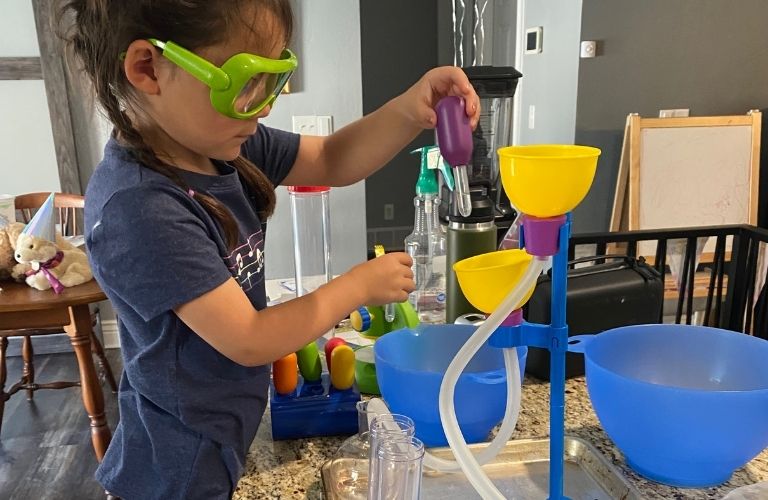
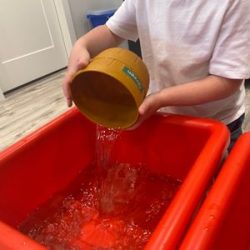
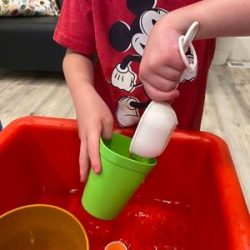
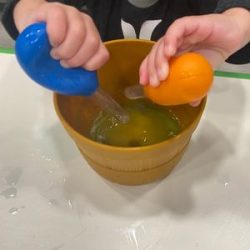
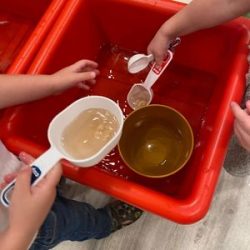
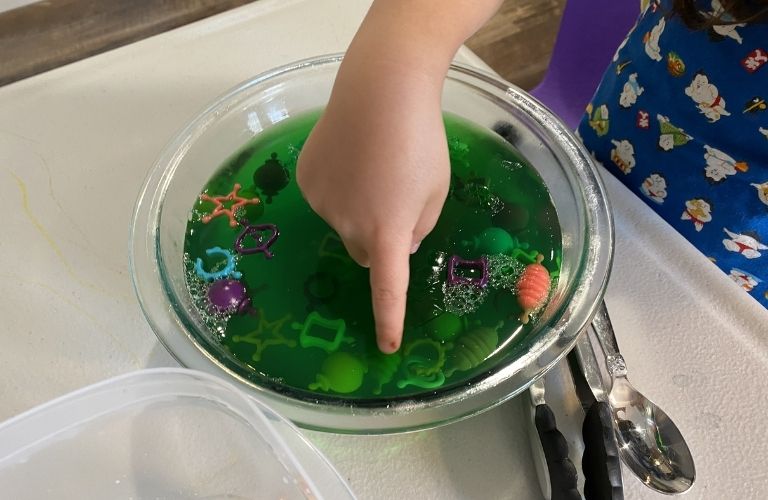
Water transfer is a simple, fun activity you can do to incorporate so many different skills, including fine motor skills, cognitive skills, and communication skills. In this post, I wanted to mostly focus on crossing midline, however you can learn how to adapt this activity to the different areas of development within the Water Transfer Tutorial.
Crossing Midline Examples
What is crossing midline and why is it important? Let’s start with some examples of crossing midline.
If a child is ready to start coloring and his favorite colored crayon is on the left side of the table, but his dominant hand is his right hand, he may cross midline to reach for that crayon. If he does not easily cross midline, then he may pick up the crayon with his left hand and transfer it to his other hand at midline (the middle of his body).
If a child is looking at pictures in a book, if she is able to cross midline easily, she may turn the pages with one hand, reaching from one side to the other. If she does not cross midline easily, she may lift the page with her right hand, transfer to her left hand and finishing turning the page with her left hand.
If a child has velcro shoes and easily crosses midline, he may velcro both of his shoes with his dominant hand. If he has a difficult time crossing midline, he may velcro his left shoe with his left hand and his right shoe with his right hand.
Activities That Require Crossing Midline
Crossing midline is something that starts to develop in infancy, and is generally fully developed mid elementary age.
Let’s talk about some every day activities that crossing midline makes so much easier, and this will give you an idea of why crossing midline is important.
Writing a sentence across a piece of paper
Tying your shoes
Getting dressed
Cooking
Eating
Throwing a ball
Bathing
Making a bed
Zipping a backpack up
Just thinking about how long and hard some tasks would be if you couldn’t cross midline makes me realize how much I take it for granted.
Water Transfer and Crossing Midline
Water transfer activities are fun for kids regardless of whether they’re working on crossing midline or not. It’s generally a motivating activity for most kids with endless ways to play.
The key for getting a lot of opportunities for crossing midline is the setup of the activity. I like this activity also because you probably have all the supplies you need. With that in mind, I do have a link below with my favorite water transfer toy. It’s a science kit I got for my daughter, and it has been a definite winner.
So, here’s a few examples of how to target the skill of crossing midline with water transfer.
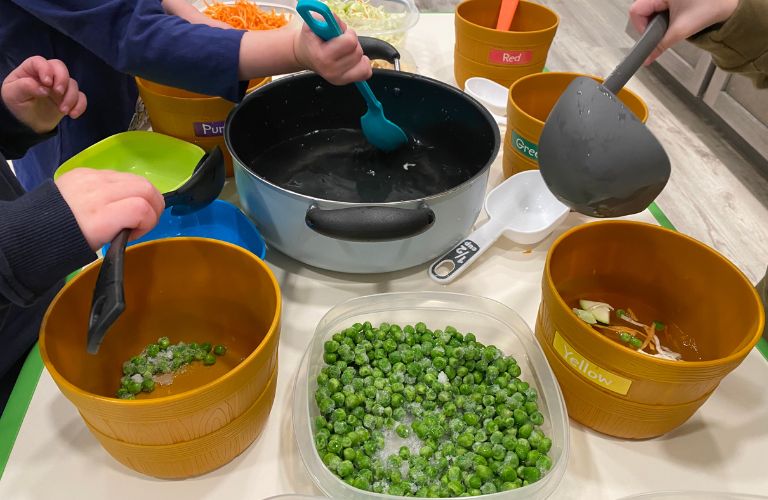
Set out two bowls, one on the left side of your child and the other on the right side. Have one bowl empty and the other full. Use a small measuring cup to transfer the water back and forth.
Give your child a bowl of water and a large cup with a handle. Have your child hold the cup handle with one hand, and let her transfer water with the other hand. This will help her not to transfer the measuring cup at midline
Have multiple bowls of water and make them different colors with food coloring. Have your child match the colored water to the same colored bowl (if you have them) or use masking tape and label each empty bowl with the color.
If you child seems to be favoring one side over the other, just move the bowls around to see if it will encourage crossing midline
Have different types of things to play with (spoons of different sizes, measuring spoons, measuring cups, eye droppers, squeeze bottles, etc.) place them in a container and have your child reach for what she wants, and put them back when she’s done.
Water Transfer Tutorial
Once you purchase the Water Transfer Tutorial and log in, you will have full access to all the content below this section.
The Functional Developmental Levels (FDL) are based on The PLAY Project and DIR/Floortime
FDL 1: Self Regulation & Shared Attention
FDL 2: Engagement & Relating
FDL 3: Intentionality & Two-Way Communication
FDL 4: Social Problem-Solving & Mood Regulation
FDL 5: Creating Symbols & Using Words & Ideas
FDL 6: Emotional Thinking, Logic & Sense of Reality
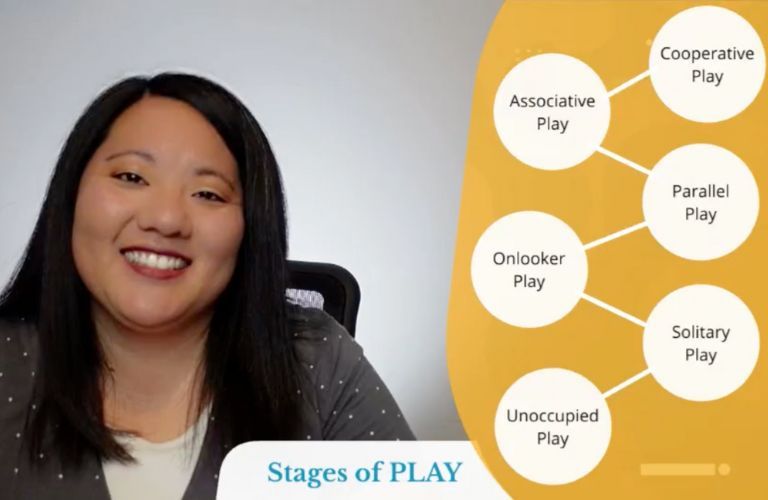
Stages of Play: 1-6
This activity is great for kids primarily participating in stages: 1-6
The Stages of Play come from Parten’s Stages of Social Play.
Stage 1: Unoccupied Play
Stage 2: Solitary Play
Stage 3: Onlooker Play
Stage 4: Parallel Play
Stage 5: Associative Play
Stage 6: Cooperative Play
Sensory Input: Tactile
This activity includes: tactile
Our senses include more than the usual 5 senses. Some kids may seek certain types of sensory input and/or avoid other types.
Visual: Sight
Auditory: Sound
Olfactory: Smell
Oral: Taste (Gustatory) and using the mouth to speak, make sounds, eat, chew, drink, etc.
Tactile: Touch
Vestibular: How we process information about movement, gravity, and balance. We receive this information through the inner ear.
Proprioceptive: How we process information about body position and body parts. We receive this information through our muscles, ligaments, and joints.
Areas of Development: Communication, Cognitive, Motor
This activity is good for targeting the following developmental skills: communication, cognitive, motor
These are the main areas of child development addressed in the Early Intervention Tutorials
Communication: receptive language, expressive language, listening, two-way communication
Cognitive skills: cause & effect, literacy, math, science, problem solving, perception and concept
Executive functioning: emotional control, flexibility, perseverance, self-monitoring, organization, planning, response inhibition, attention, task initiation, time management, working memory
Motor skills: fine motor, gross motor, perceptual motor
Social-emotional skills: peer interaction, self concept & social role, pretend play, behavior, group activities
Adaptive skills: self-care, personal responsibility
Supply Ideas
Bowls
Spoons
Measuring cups
Eye droppers
Instructions
Fill some bowls with water
Give your child different spoons, cups, or eye droppers
Allow your child to explore (even if it gets messy)
Links
As an Amazon affiliate, I earn from qualifying purchases at no cost to you.
Science Kit-I highly recommend this science kit. It’s so much fun for kids. you can just use water, or you can add food coloring to mix colors. You can also add vinegar and baking soda for some variety. It’s fun with the different beakers, eye droppers, tubes, and microscope.
This is a great activity to help kids increase attention on an activity
Allow your child to lead the play
This activity is fun at all stages of play, from cause and effect play to pretend play
Adapt how you’re playing according to you’re child’s stage of play or what developmental skills you’re trying to target
This activity is great for fine motor skills, crossing midline, bilateral coordination, eye-hand coordination and more.
Video Tutorial
Adapting to Different Stages of Play
Stages 1-4
At stages 1-2 kids may not be very interested in other people yet. At stages 3-4, kids are typically starting to be interested in other kids, but aren’t engaging in play with them yet.
Our main focus at stages 1-4 is going to be attention, engagement, and simple circles of communication (even if it’s just 1-3 circles at a time).
This activity is good for
GOALS:
Increase attention to one activity
Engage in play with a familiar adult
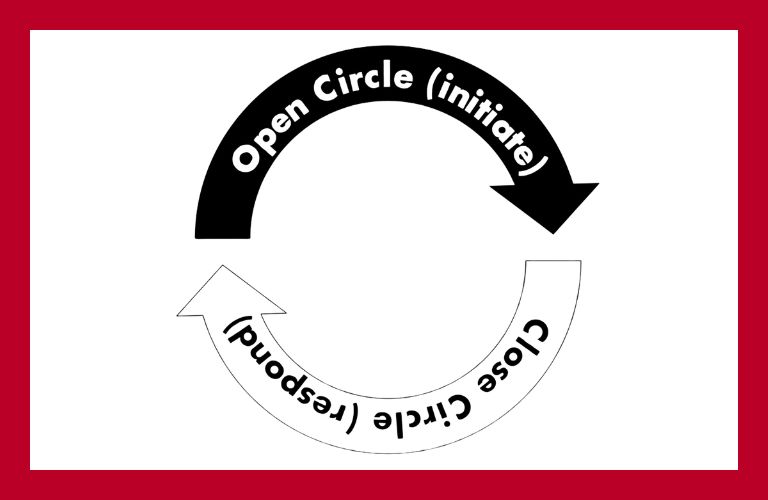
Initiate wants and needs through words, sounds, gestures, or facial expressions (open circles of communication)
Will respond when you open a circle of communication (close circles of communication)
Explore different textures
Participate in cause and effect activities
Increase time participating in parallel play (playing next to a peer with like materials)
Increase natural imitation
Participate in purposeful interactions
TIPS FOR PLAYING WITH A CHILD AT THESE STAGES
Kids at these stages are not ready to share, so make sure everyone has their own supplies. If you want a child (who doesn’t generally engage with you) to play with you, stop stealing her toys.
If you’re having a difficult time getting your child to engage with you, it’s ok to just sit near your child and be with each other
Instead of trying to get your child to imitate you, try imitating your child. Sometimes this helps pique your child’s interest in you
Our goals at these stages are attention, engagement, and circles of communication. Try playing without giving any directions or asking any questions. Instead, narrate what’s happening.
Stages 4-5
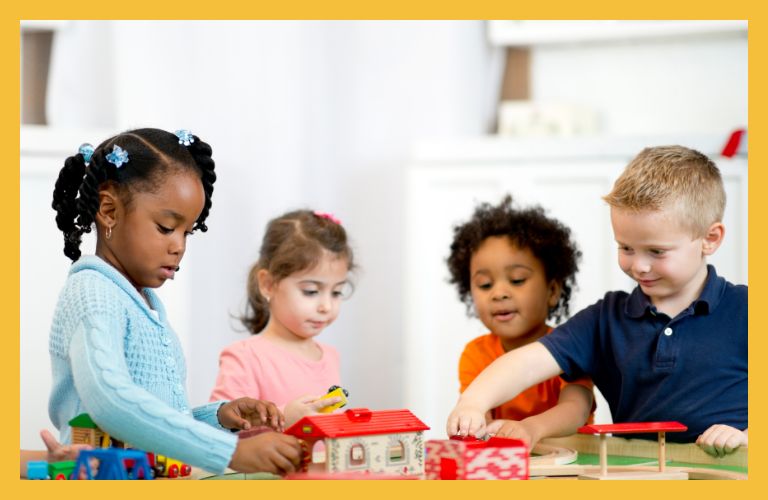
These two stages are when kids are starting to be more interested in other kids. They may not be playing cooperatively yet, but they’re playing near each other and playing similar things.
GOALS:
Increase the amount of time participating in an activity next to a peer
Increase interaction with a peer
Increase circles of communication with adults and peers
Work on sequencing (motor planning) to executive an idea
Participate in simple pretend play. More complex pretend play comes later.
Our goals here are more engagement, pretend play, and circles of communication. Fight the urge to give a lot of instructions, we’re still not working on following directions here.
Increase purposeful interactions
Sustain purposeful interactions for longer periods of time
TIPS FOR THESE STAGES
Kids that are just beginning to participate in parallel play may not be ready to share yet, and that’s ok. Have separate supplies for each participant.
Kids that are participating more in associative play may be more ready to share some (probably not all) of the supplies. So, have some things to share and some things that each kid can have.
As kids start participating more in parallel play their imitation skills will typically increase as well. If you only have one child participating, then you can participate too.
Don’t give too many directions, allow your child to explore and come up with ideas of their own. Make comments about their ideas. You can say things like “wow, I like how you added sugar to your stew, I’m going to do that too!”
Instead of giving directions of what to do, you can narrate what you are doing and narrate what your child is doing as well. Remember, narrators don’t direct.
Adults are always more predictable than peers, so developmentally kids will usually play and do things with adults before peers.
Stages 5-6
These stages are when kids are starting to interact more with each other, communicate with each other, and negotiate with each other. This is also when kids start to do more complex pretend play.
GOALS:
Imitate motor actions
Imitate pretend play
Follow one-step directions
Follow multi-step directions
Share ideas through conversation
Act as a character in role-play
Create a drama that “make sense” with a beginning, middle, and end
Will have more than one theme within the pretend play
Give a turn to a peer when asked
Ask for a turn
TIPS FOR THESE STAGES
Allow your child to take the lead with the pretend play, but also throw in your ideas. Make it balanced.
Before you start doing this activity, talk about what you want to do, maybe choose roles
Now is the time when it’s ok to ask questions and give some directions. No one likes being bossed around or quizzed during playtime though, so be careful how often you’re doing it. Be purposeful. Don’t ask questions you know the answers to, ask questions to find out what your child is thinking.
Ideas for pretend play: restaurant, making dinner at home, baking for a party, scientists, going to the grocery store for ingredients
Developmental Skills
In this section, I will give you specific examples of what you can do in this activity to address specific areas of development.
Communication skills
Receptive Language
Receptive Language (Understanding language)
For kids who are not using more than 1-2 word sentences independently, use salient language throughout this activity. This means you’re emphasizing certain words, or just using one word as you speak. For example you might say things like “water” or “pour” or “splash”
You could have different colored water and as your child uses the different colors you can label the color.
Narrate what your child is doing, give everything your child is doing a word. This will help your child hear the words as they’re experiencing the activity.
Give simple 1-step directions. You can say things like “I need the red spoon, where is the red spoon?” or “I can’t reach the green cup, can you get it for me?” Make it a natural interaction rather than quizzing. If your chid hands you the correct item, you can say something like “thanks for giving me the RED spoon! You’re such a great helper.” and if your child hands you the wrong thing, you can say “this is the BLUE spoon, I need the RED spoon (point to it) there it is!”
Expressive Language
Expressive Language (Using words, gestures, or writing to express oneself)
For kids who are working on initiating, do some playful obstruction by putting some items in closed containers. Then wait for your child to initiate that he wants it opened.
Another playful obstruction would to be to give just a little bit of water at a time so that your child wants to ask for more.
For kids who are able to have conversations (small or big), talk about what you’re doing with the water.
Cognitive skills
Cause & Effect
Playing with water is a great way to work on cause and effect. It’s fun and engaging and there’s a lot you can do.
Pouring is a great cause and effect activity
Fill the water with bubbles, scoop up some bubble and blow them off your hand. See if your child imitates.
Get some water toys where you can pour water and watch the wheel spin (I’ll put an example in the link section). Or toys where you can watch the water go down the tubes.
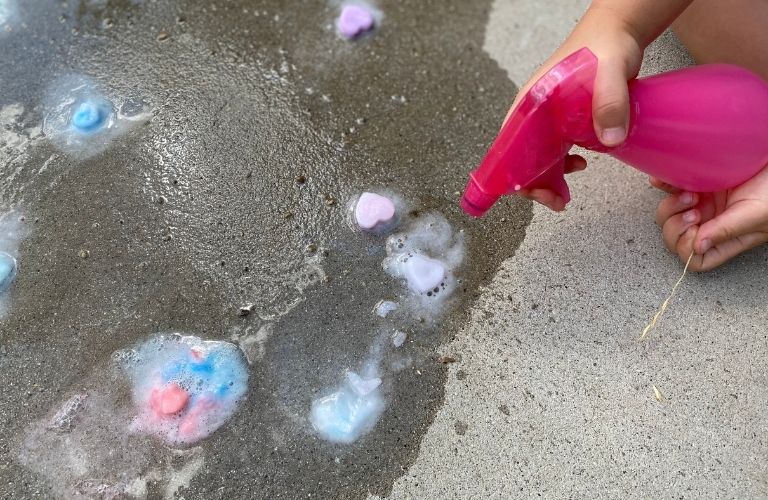
Get some chalk and a spray bottle. After drawing with the chalk, spray it with water and watch it “melt”
Pre-Math Skills
You can work on different math skills as you play.
Color recognition with different colors of water, bowls, spoons, etc.
Make “recipes” for a more structured type of activity. For example: pour 3 cups of red water in the bowl, add 5 spoons of blue water, etc.
Cut out some shapes and tape them on some cups or bowls. Name the shape to put water in as you go.
Find out how many cups of water fit in one bowl.
Science
You can turn this into a fun little science activity for kids who are ready for that. If you’re mostly working on initiating and engaging, I wouldn’t make it too complicated.
Experiment with colors. Let your child figure out what colors to combine to make a new color.
Have different sized containers to see how full each one gets with the same amount of water.
Add some vinegar and baking soda for a little fizz
The science kit (in the link section) has cards included with different experiments you can do. It’s such a great set.
Motor Skills
Fine Motor Skills
Fine Motor (skills that involve the small muscles of the body)
Scooping, pouring, and transferring water without spilling it all is a good way to work on fine motor skills.
Use other tools like eye droppers. They’re fun and they also take some coordination.
Use squeeze bottles to help work on hand strength
Use tweezers to pick up little things to put in the wa ter.
Perceptual Motor Skills
Perceptual Motor (coordinating senses and motor skills to interact with the environment)
–Bilateral Coordination (using both sides of the body together in one activity)
Get squeeze bottles that require both hands to use
Have your child hold a cup in one hand and a spoon in the other and scoop things out of the cup with the spoon
–Crossing Midline (moving one limb across midline to the other side of the body)
This is all about placement of items. Put one bowl on one side of the body and the water on the other side of the body.
If your child swaps items at midline, try having your child hold two different things in each hand. For example, one hand could have a spoon in it, and the other hand could have an eyedropper.
When you hand things to your child, hand it to them in a way that will have them cross midline
See blog post at the top of the page for more ideas on crossing midline.
–Eye-hand Coordination
Pouring water into tubes or cups is great for eye-hand coordination.
Also trying not to spill the water is also great for eye-hand coordination.
–Motor Planning (being able to perform a sequence of movements to complete a task)
Giving your child opportunities to create her own activity is great for motor planning.
Have several options of things to do rather than just one.
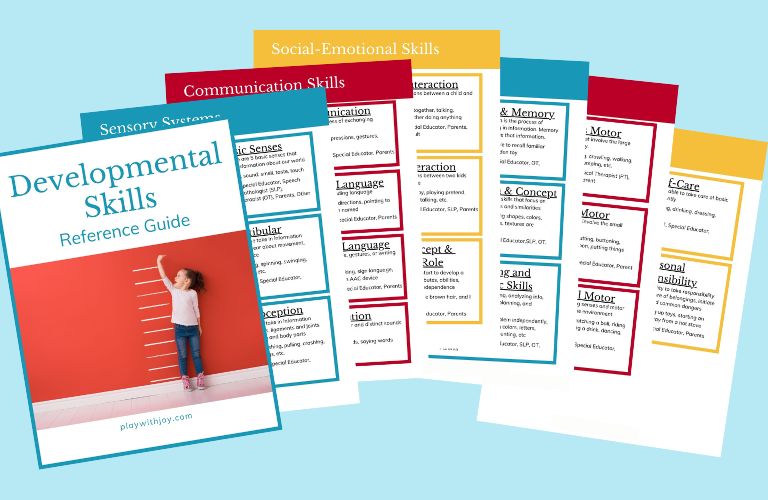
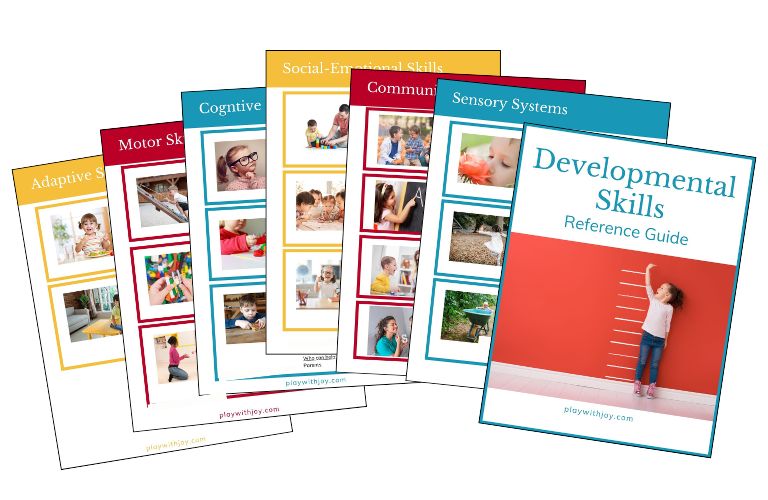
Get Your Free Developmental Skills Reference Guide
Parents, educators, and therapists – Add this to your toolbox to better understand key areas of child development. Plus get extra tips, activities and strategies to your inbox.
Unsubscribe at any time. See Privacy Policy for more details.