Early intervention is all about giving extra help and support to a child that has developmental delays. Every child is different and needs different supports. It’s important to be aware of where the child is developmentally so that you can help in the best way possible.
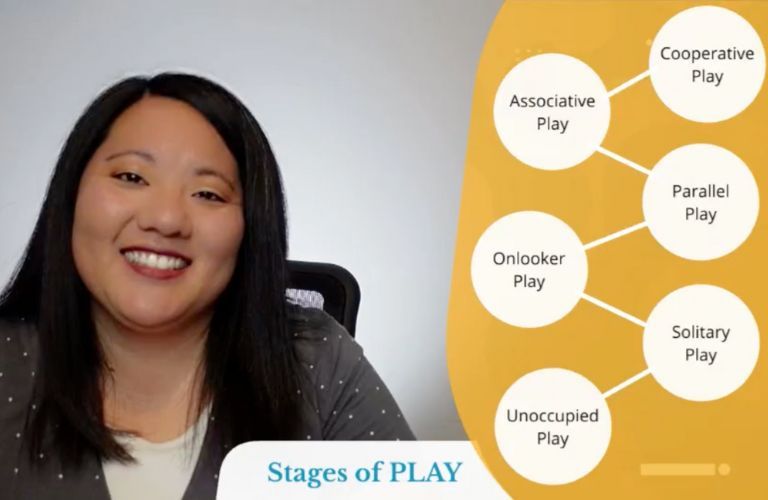
For today I’m going to primarily focus on kids that are participating in associative play and/or cooperative play.
You can obviously still play with a flashlight with kids who are at stages 1-4 of play, but the play will be different than what I’m going to focus on in this post. For ideas on how to do this activity with a child at stages 1-4, you can find more info in the Flashlight Games Tutorial.
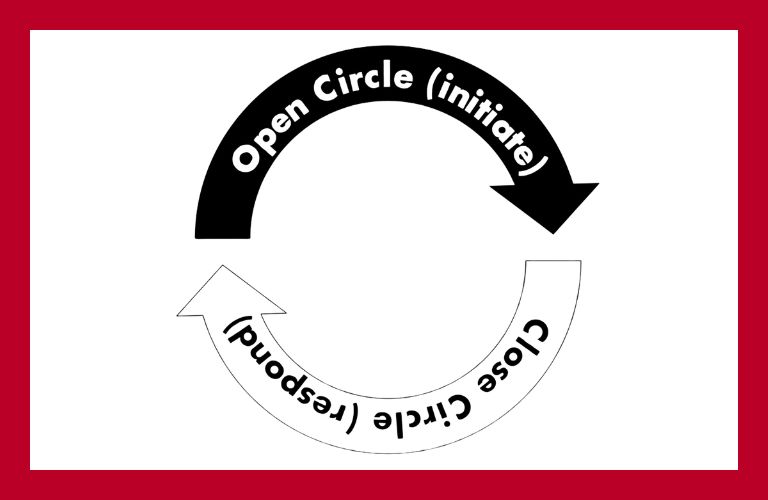
When a child is participating in associative and cooperative play, it generally means that the child is able to have continuous back and forth (circles of communication) interactions with others. They are also at a stage where they can follow some mutli-step directions, and are able to answer some questions.
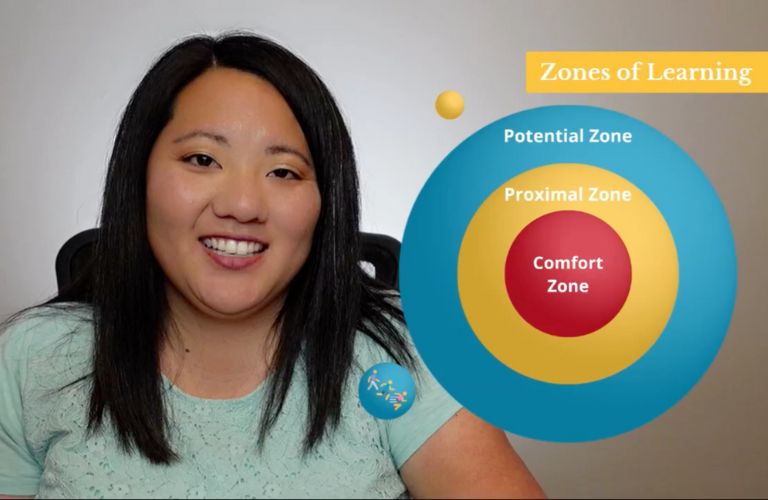
Most of the activities I’ll be suggesting are on the premise that the child you’re playing with is able to do those things. It’s always important to make sure you’re playing at the right level if you want the most progress. If things are too easy or too difficult you won’t see as much growth.
The first game is a simple game of I-spy. I know that you may or may not live in the United States, and this may not be a familiar game, so I’m going to briefly explain it.
I-Spy
One person thinks about an object in the room and the others have to guess what it is
The first person will say “I spy with my little eye (or light in this game), something…(then the person gives one descriptive word. It could be a color, shape, size, texture, etc.)
Then the other person/people start making guesses by shining their light on objects in the room.
If your child is working on receptive language skills, this game is perfect. If your child is working on recognizing the color green, then make sure that when you play, you spy something green. Then your child has so many opportunities to identify green objects in the room by pointing to them in the room.
If your child is working on expressive language, this is also great. If your child is working on naming colors, then when it’s your child’s turn, you can take the opportunity to guess the wrong things and see if your child will tell you what color it is instead.
This game is also great for
eye-hand coordination
working memory
perception and concept
attention
Shine A Light Books
Another activity I wanted to share with you are these awesome books. They’re called Shine A Light Books. There are hidden pictures throughout the book that you have to shine a flashlight behind the page to discover what it is. Kids love it, and you can make it a fun interactive game as you read together. I’ll post links at the below so you can find them. These books are great for
You can play so many games with a flashlight, try to come up with your own
Think of games your child is already great at playing, and see if you can add a flashlight to change it up a little
I will share more games and activities in the Developmental Skills section where I’ll show you how to target specific skills
Video Tutorial
Adapting to Different Stages of Play
Stages 1-4
Our main focus at stages 1-4 is going to be attention, engagement, and simple circles of communication (even if it’s just 1-3 circles at a time)
Avoid asking too many questions or drilling with “what is that?” type of questions
Focus on cause & effect play by turning the flashlight on and off. You can add rhythm and music by turning the flashlight on and off while singing to the tune of London Bridges “Lights go on and lights go off, lights go on, lights go off. Lights go on and lights go off, on and off!” Build up a routine, and then start to pause (and wait expectantly) during the song to see if your child will initiate turning the light on or off and continuing with the song.
Play a simple game of Peek-A-Boo with the flashlight shining on your face. Turn the light off and then when you say “boo” shine it on your face
Use salient language to name things around the room. Shine the light on different objects while naming them.
Give the flashlight to the child, and whatever they shine their light on, narrate what you see
Play chase in a dark house with a flashlight.
Have a dance party with flashlights, just working on engagement and having a fun time together
Stages 5-6
These stages are when kids are starting to interact more with other people, they’re able to have continuous circles of communication. They’re also able to answer some questions, and follow more directions and follow simple rules.
GOALS:
Follow one-step directions
Follow multi-step directions
Increase time engaged in conversations
Share ideas through conversation
Give a turn
Ask for a turn
Negotiate with an adult or peer
Connect ideas that make sense
TIPS FOR THESE STAGES
Add pretend play to the games you’re playing.
Go on an expedition with the flashlights.
Search for bears in a cave
Go on a spaceship and explore space
Now is the time when it’s ok to ask questions and give some directions. Doing this with a game, makes it more fun and engaging. I generally say, don’t ask questions you know the answers to. For example, you could ask “what color is your favorite?” instead of “what color is this?”
Play I-spy
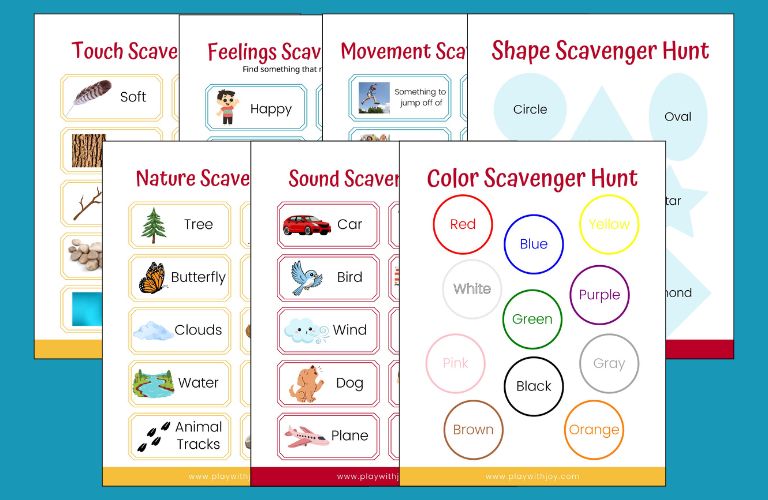
Go on a scavenger hunt. Print out a paper of items to find in your house, and go looking for them together
I’ll get to more specific games in the Developmental Skills section.
Developmental Skills
In this section, I will give you specific examples of what you can do in this activity to address specific areas of development.
Communication skills
Receptive Language
Receptive Language (Understanding language)
A scavenger hunt is a fun way to work on receptive language
Turn all the lights out in the house
Give your child a flashlight
Name an object for your child to go find and bring back to you
You could name a specific object to find
Name categories like shapes, colors, something soft, something big
Use prepositions. Find something under the table, behind the couch, etc.
Set out pictures of animals, make an animal sound, and have the child shine a light on the animal that makes that sound
Play simon says with the flashlight. Simon says to shine a light on your hair, shine it up high, make a big circle with your light
Expressive Language
Expressive Language (Using words, gestures, or writing to express oneself)
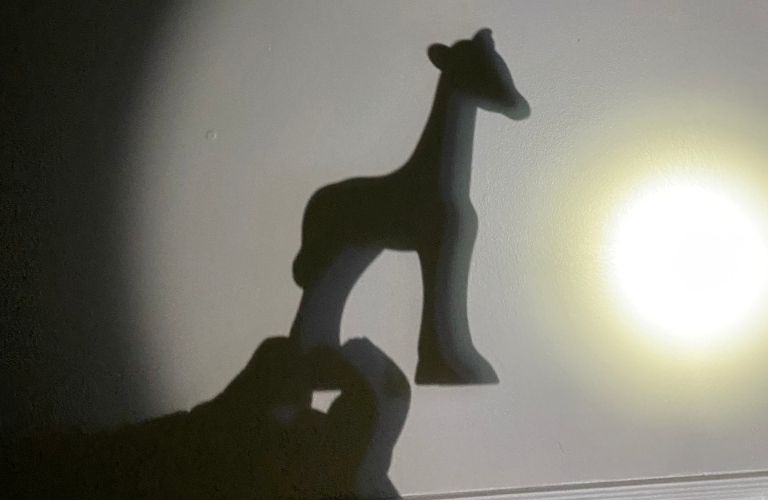
Guess the shadow
One person holds the flashlight and casts a shadow on an object of their choice while the other people guess what they think it is
You can work on naming familiar objects with this fun activity. Isn’t this way more fun than sitting at a table saying “what’s this?” over and over?
Storytelling. Take turns sharing parts of the story by shining your light on an object and adding it to the story
I-spy works for receptive language when you are the one naming what you spy, and it works on expressive language when the child is the one spying what they see
Two-Way Communication
I spy is a great activity for two-way communication. It’s all about being connected, trying to figure out what the other person is thinking. You have to be engaged with one another, listen to the clues, listen to the answers and go back and forth with one another.
Bring in pretend play and discuss ideas together of what’s going to happen
Cognitive skills
Cause & Effect
I already mentioned this in the Stages of Play section, but playing a simple on/off game with a flashlight is great for kids who are engaging in cause and effect activities.
To encourage more circles of communication, set up a routine. You could pretend to go to sleep every time the light goes off and do a dramatic wake up every time the lights go on. Help your child get into the sequence. Then when you know your child is engaged and most likely wants more, give long pauses. Wait for your child to initiate more, whether it’s by turning on the light, asking for more, or just the anticipation on his face.
Just go for more and more circles of communication!
Pre-Literacy Skills
As I mentioned in the blog post, you can get Shine-A-Light books and discover pictures in the book using a flashlight.
In most books it describes something and then asks what it is, so you can guess with your child and predict what it might be before shining the flashlight on the page.
You could also go on a scavenger hunt in the book looking for different objects throughout the pages.
Pre-Math Skills
Count as you hit the balloon back and forth
Have a bunch of balloons on the floor, say a number and the child gathers that many balloons and puts them in a basket
Put numbers on the balloons and say a number and the child then hits the balloon that many times
Work on color identification
Draw a shape and number on a balloon. Name a shape, number, or color and see who can find it first
Perception & Concept
Perception and Concept (Examining differences and similarities)
I-spy: the child must survey the room or the environment to find what is similar to what you described and what is different.
Scavenger hunt (see Receptive Language Section): as the child searches around the house for specific objects or objects in a specific category, she must analyze similarities and differences with everything around her
Guess the shadow (see Expressive Language Section). The child has to compare similarities and differences of things that the child has seen in the past to guess what it is.
Executive Functioning skills
Perseverance
Perseverance (completing a task even if it’s difficult or non-preferred)
Guessing games or scavenger hunts can get difficult when a child keeps guessing the wrong answers. You can work on perseverance on these types of games to keep going and not give up.
This helps build frustration tolerance as well, however remember that this is supposed to be a fun enjoyable exchange, so don’t push so hard that you lose the child’s interest in engaging in play with you.
Response Inhibition
Response Inhibition (impulse control, being able to wait a turn, wait for directions, and think before going into action)
You can play an on/off game where the child can only turn the light on when you say “on” and then they have to wait. Kind of like a very simple Simon Says game.
It can be hard not to turn a light on and off at times, if you’re working on response inhibition, you can give instructions to wait for the count of 5. Then vary how fast and slow you count to 5 before turning on the light.
Attention
Attention (focusing and taking in information even when there are distractions or if it’s boring)
Using engaging games and activities is the first step to increasing attention. Starting with something hard or boring for the child may take much longer to gain the attention needed for learning.
You can take a lot of common games and just add the novelty of using a flashlight to increase engagement on that game.
Any activity that includes pointing at something, you can use a flashlight for.
Working Memory
Working Memory (the ability to remember information while performing a complex task)
Playing games like guess the shadow or I-spy in a dark room or a scavenger hunt in the dark requires the child to remember where things are in the house.
If you say find something “red” the child has to remember what in the house is red, and where it might be located.
The child then has to remember the direction even though she’s creating distance between the instruction and giving the answer. This is great for working memory.
Give multiple directions at a time to also work on memory
Motor Skills
Perceptual Motor Skills
Perceptual Motor (coordinating senses and motor skills to interact with the environment)
While playing I-spy, instead of giving a clue of what you’re thinking of, give directions to the object
You’ll mostly use up/down, left/right directions, but if your child doesn’t know left/right yet, you can say “towards the door” or “above the bed” or “under your clock”
The child then follows your directions by moving their flashlight.
–Eye-hand Coordination
Using a flashlight to point to things is great for eye-hand coordination
–Visual-Spatial Perception (being able to tell where objects are in a defined space)
Shining a flashlight is also good for visual-spatial perception as the child has to determine where something is from a distance and then the spotlight of the flashlight also gives it more defined space.
Social Skills
Social-Emotional
If you’re working with more than one child, you can incorporate social skills into any of these games
Taking turns
Following each others’ directions
Working as a team to find an item
Negotiating who will go first
Creating opportunities of conversation
Asking each other questions and answering
Pretend to be detectives looking for clues as you’re on the scavenger hunt
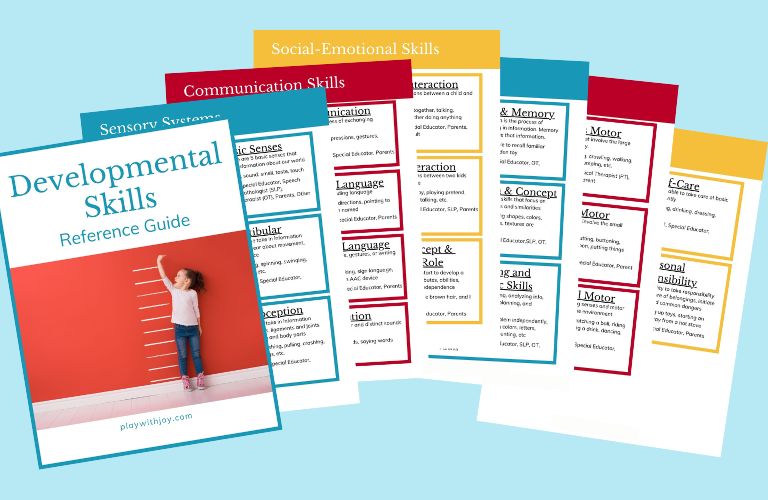
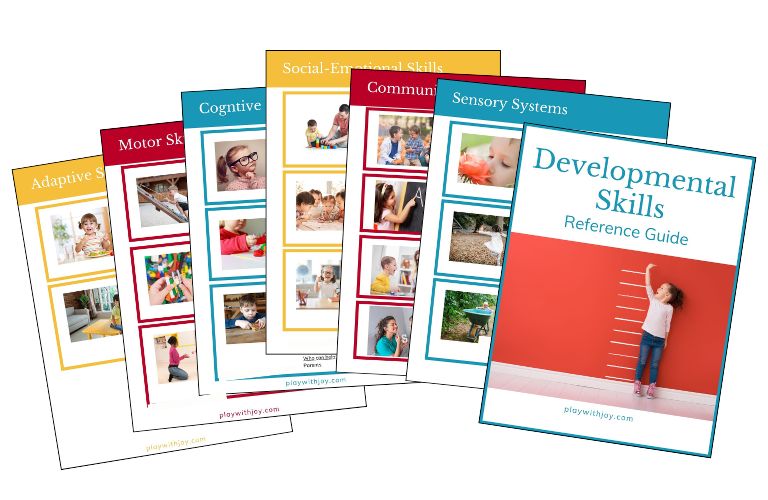
Get Your Free Developmental Skills Reference Guide
Parents, educators, and therapists – Add this to your toolbox to better understand key areas of child development. Plus get extra tips, activities and strategies to your inbox.
Unsubscribe at any time. See Privacy Policy for more details.