Exercise Ball

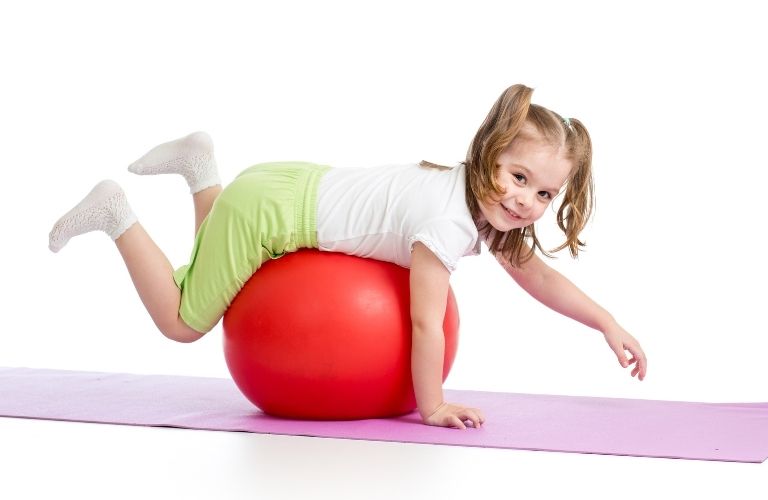
An exercise ball is one of my must-haves when working in Early Intervention or Preschool Classes.  This is a great activity IF your child enjoys vestibular or proprioceptive input. If your child avoids these types of activities, you can still try it, but you’ll need to be sensitive to your child’s preferences and go at a much slower pace

I have found that using a lot of sensory motor activities not only increases engagement (because it’s fun!) but it also increases communication and motivation.

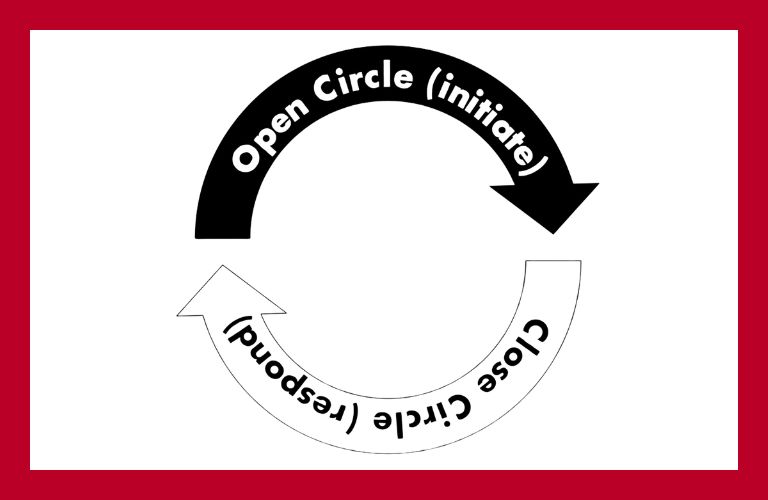
I’ve had several kids I’ve worked with that have started initiating (opening circles) more and using more words just from doing activities like bouncing on a ball.

What you want to do first is create some type of sequence or routine. For example if your child likes to sit on top of the ball and have you bounce him, then do that. The sequence may look something like this:

  • Put your child on the ball and say “up” or “on”
  • Say “1,2,3, Go”
  • Start bouncing
  • Sing a song or just melodically and rhythmically say “bounce, bounce, bounce”
  • Say “stop” and stop bouncing
  • Take your child off the ball

If this is the first time you’re doing the activity, then set up the sequence by doing it several times until you know your child is engaged and wants more. Once your child is fully engaged, then the next time you finish the sequence just wait. Don’t say anything, just use facial expressions.

As soon as your child does anything to indicate he wants more, then put him on the ball. This can be anything, your child may use a full sentence to ask more, or your child may try to get on the ball by himself. Whatever your child does, don’t discount it. This is communication.

Sometimes adults will discount a child’s attempt at communication just because it’s not how the adult wants the child to do it. Please don’t do this. Our goal with this activity is to get more and more circles of communication (initiating and responding). If you ignore your child’s attempt to communicate, you’re stopping the flow and thus forfeiting him the chance to increase those circles.

As your child increases his consecutive circles of communication, and as his motivation increases, you just might hear more verbal words as well.

Using an exercise ball in Early Intervention is not only good for communication, but it can be calming for kids that are disregulated. You can also use an exercise ball to work on cognitive skills, motor skills, and even pretend play. 

Exercise Ball Tutorial

Once you purchase the Exercise Ball Tutorial and log in, you will have full access to all the content below this section.

This activity is great for kids at an FDL of: 1-6

The Functional Developmental Levels (FDL) are based on The PLAY Project and DIR/Floortime

  • FDL 1: Self Regulation & Shared Attention
  • FDL 2: Engagement & Relating
  • FDL 3: Intentionality & Two-Way Communication
  • FDL 4: Social Problem-Solving & Mood Regulation
  • FDL 5: Creating Symbols & Using Words & Ideas
  • FDL 6: Emotional Thinking, Logic & Sense of Reality

This activity is great for kids primarily participating in stages: 1-6

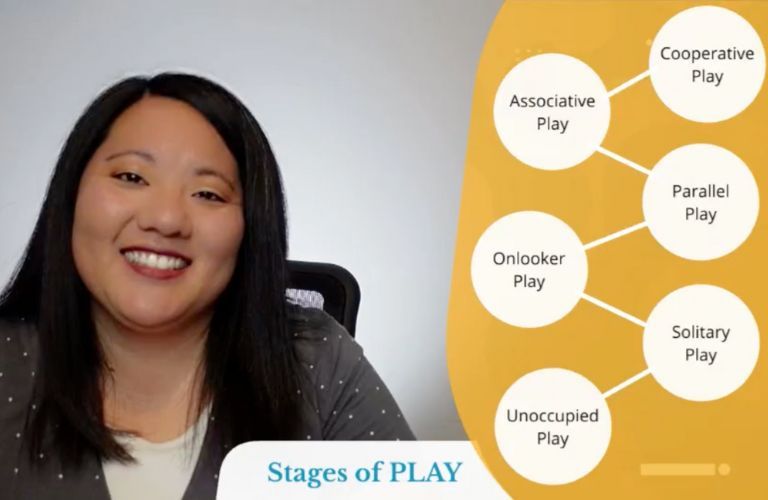
The Stages of Play come from Parten’s Stages of Social Play.

  • Stage 1: Unoccupied Play
  • Stage 2: Solitary Play
  • Stage 3: Onlooker Play
  • Stage 4: Parallel Play
  • Stage 5: Associative Play
  • Stage 6: Cooperative Play

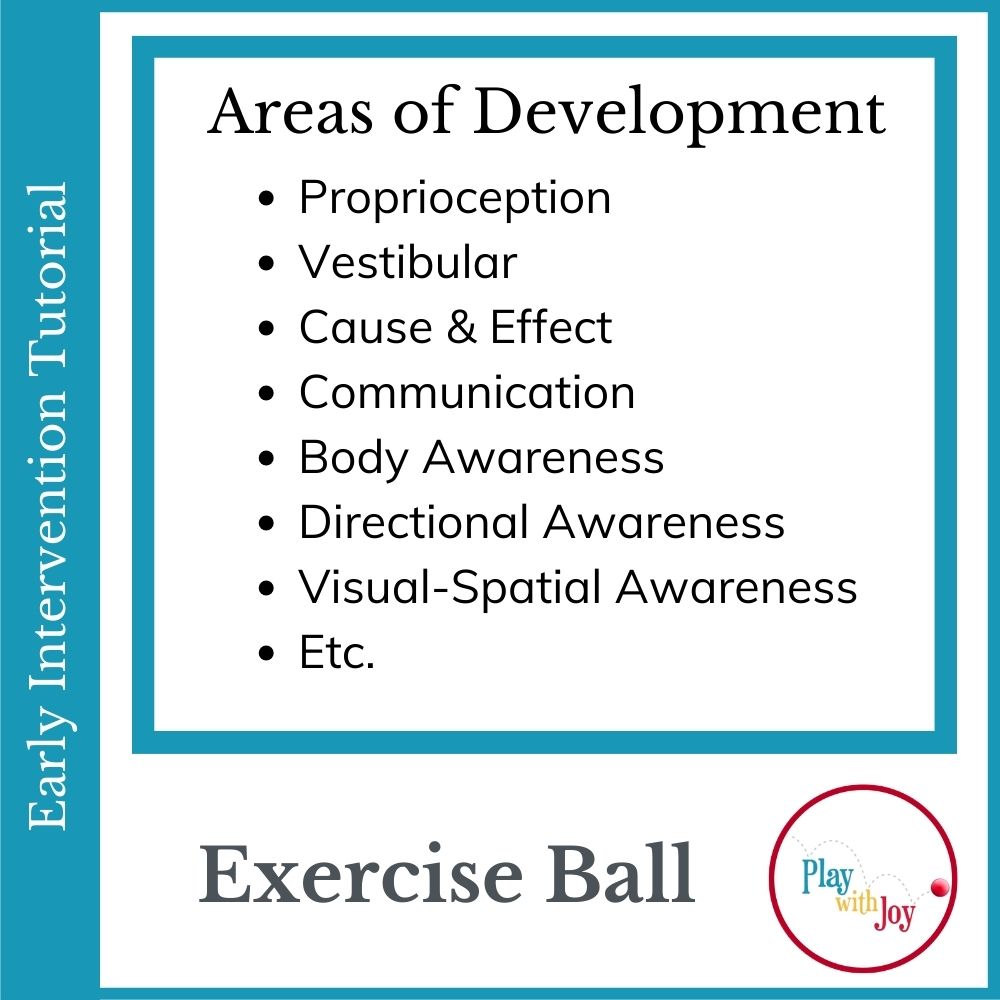
This activity includes: vestibular and proprioception

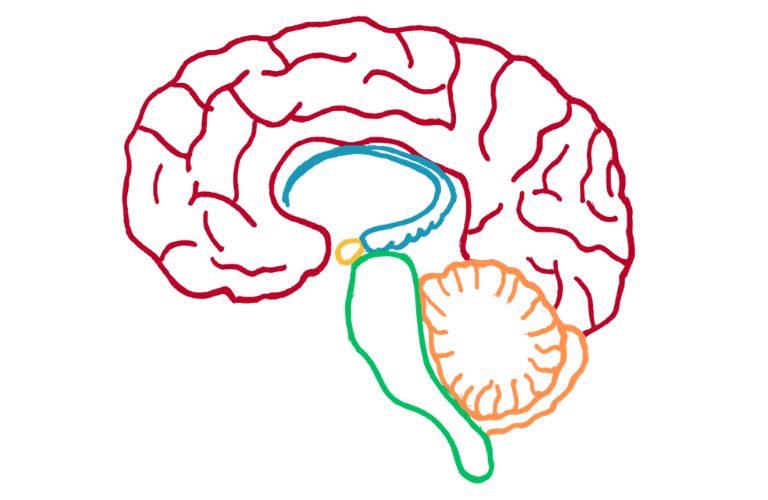
Our senses include more than the usual 5 senses. Some kids may seek certain types of sensory input and/or avoid other types.

  • Visual: Sight
  • Auditory: Sound
  • Olfactory: Smell
  • Oral: Taste (Gustatory) and using the mouth to speak, make sounds, eat, chew, drink, etc.
  • Tactile: Touch
  • Vestibular: How we process information about movement, gravity, and balance. We receive this information through the inner ear.
  • Proprioceptive: How we process information about body position and body parts. We receive this information through our muscles, ligaments, and joints.

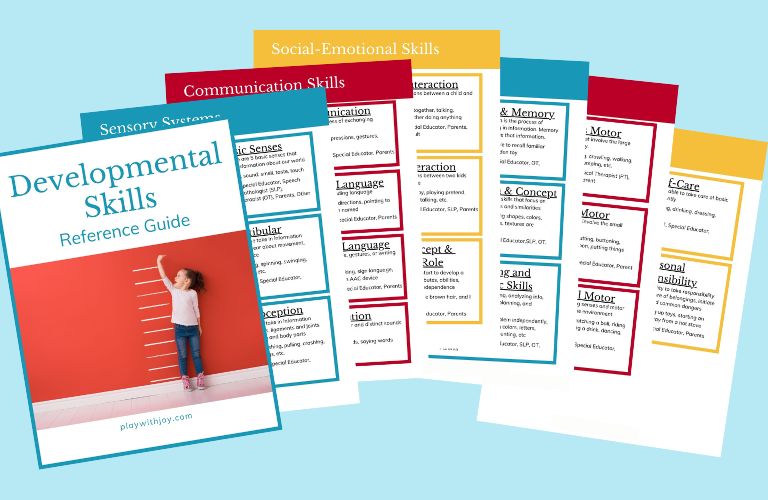
This activity is good for targeting the following developmental skills: communication, cognitive, motor, social

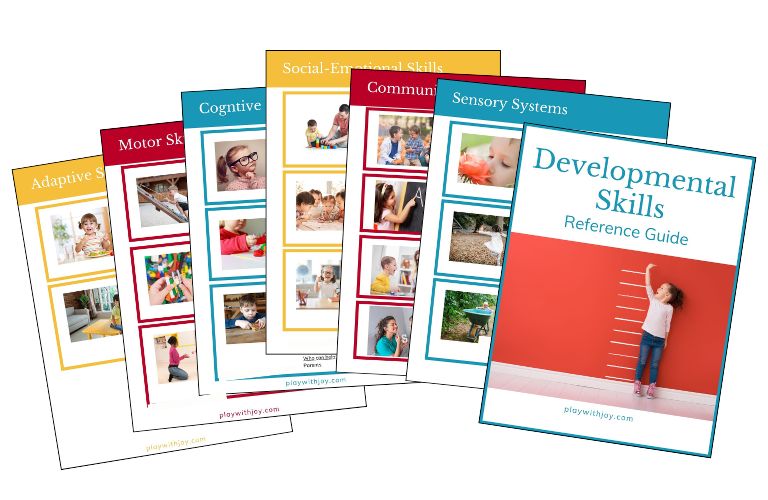
These are the main areas of child development addressed in the Early Intervention Tutorials

  • Communication: receptive language, expressive language, listening, two-way communication
  • Cognitive skills: cause & effect, literacy, math, science, problem solving, perception and concept
  • Executive functioning: emotional control, flexibility, perseverance, self-monitoring, organization, planning, response inhibition, attention, task initiation, time management, working memory
  • Motor skills: fine motor, gross motor, perceptual motor
  • Social-emotional skills: peer interaction, self concept & social role, pretend play, behavior, group activities
  • Adaptive skills: self-care, personal responsibility

Supplies

  • Exercise ball

Instructions

There are so many ways to play with an exercise ball, here are just a few:

  • Bounce your child on the ball
  • Bounce the ball on your child
  • Sing Row your boat on the ball with different actions. Row your boat, bounce your boat, sway your boat, wiggle your boat, tickle your boat, etc.
  • Roll the ball to each other
  • Roll the ball down the stairs or down a slide
  • Give your child a massage by rolling the ball on him
  • Have your child lay on her stomach while you roll the ball
  • Bounce a stuffed animal on the ball
  • Pretend the ball is chasing your child

Links

As an Amazon affiliate, I earn from qualifying purchases at no cost to you.

Extra Tips & Ideas

Adapting to Different Stages of Play

Developmental Skills

In this section, I will give you specific examples of what you can do in this activity to address specific areas of development.

Communication

Cognitive

Motor Skills

Social Skills

Download

More Blog Posts

Leave a Reply

Your email address will not be published. Required fields are marked *

Login to access your content