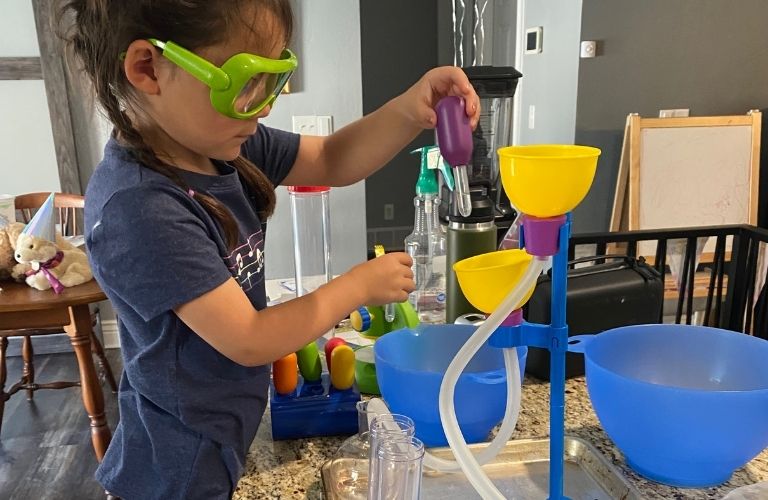
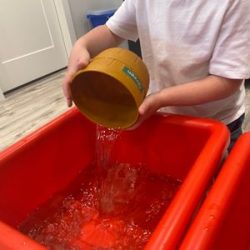
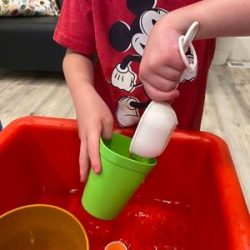
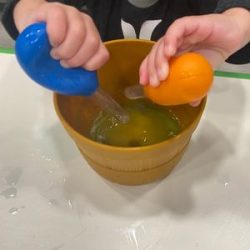
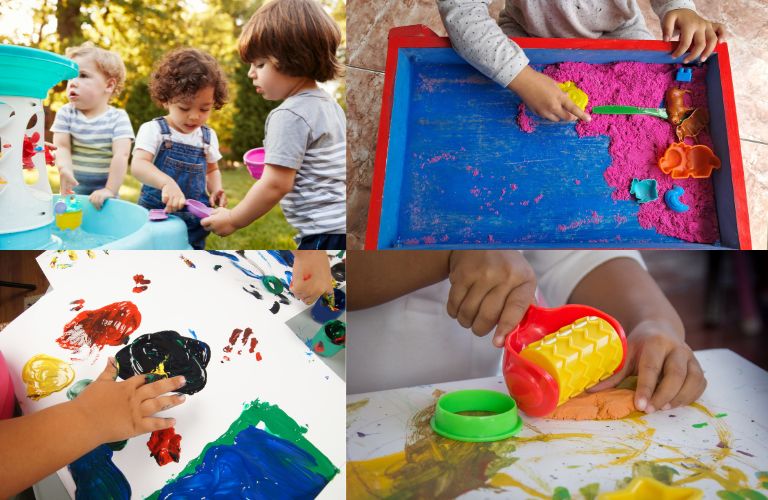
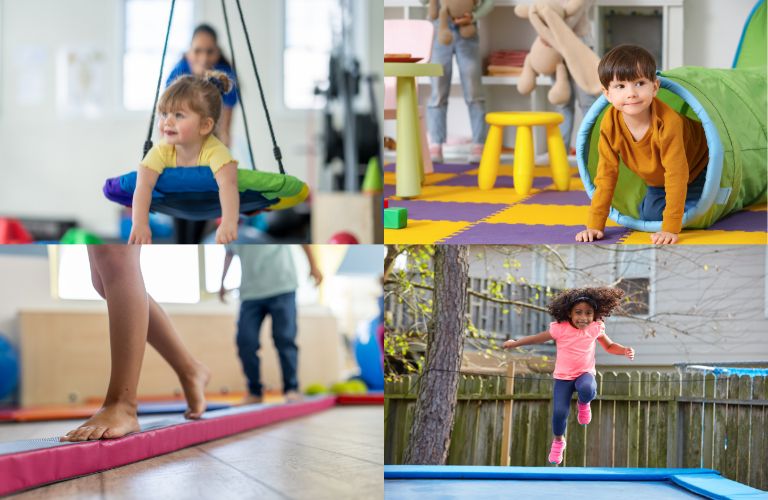
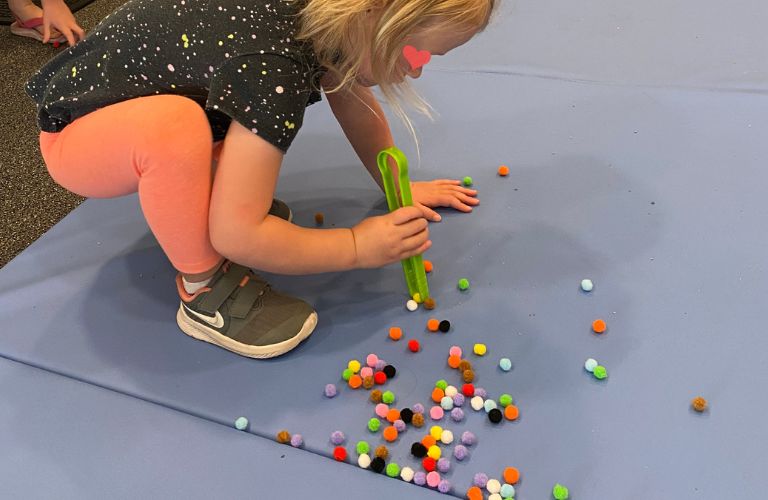
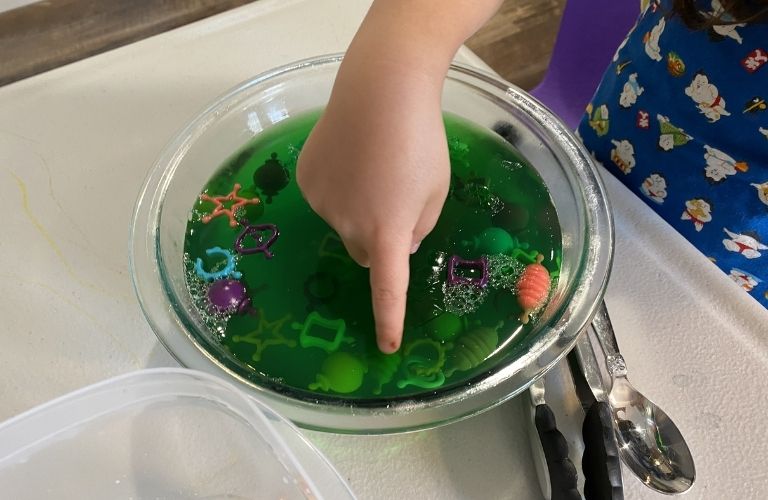
Water transfer is a simple, fun activity you can do to incorporate so many different skills, including fine motor skills, cognitive skills, and communication skills. In this post, I wanted to mostly focus on crossing midline, however you can learn how to adapt this activity to the different areas of development within the Water Transfer Tutorial.
Crossing Midline Examples
What is crossing midline and why is it important? Let’s start with some examples of crossing midline.
If a child is ready to start coloring and his favorite colored crayon is on the left side of the table, but his dominant hand is his right hand, he may cross midline to reach for that crayon. If he does not easily cross midline, then he may pick up the crayon with his left hand and transfer it to his other hand at midline (the middle of his body).
If a child is looking at pictures in a book, if she is able to cross midline easily, she may turn the pages with one hand, reaching from one side to the other. If she does not cross midline easily, she may lift the page with her right hand, transfer to her left hand and finishing turning the page with her left hand.
If a child has velcro shoes and easily crosses midline, he may velcro both of his shoes with his dominant hand. If he has a difficult time crossing midline, he may velcro his left shoe with his left hand and his right shoe with his right hand.
Activities That Require Crossing Midline
Crossing midline is something that starts to develop in infancy, and is generally fully developed mid elementary age.
Let’s talk about some every day activities that crossing midline makes so much easier, and this will give you an idea of why crossing midline is important.
Writing a sentence across a piece of paper
Tying your shoes
Getting dressed
Cooking
Eating
Throwing a ball
Bathing
Making a bed
Zipping a backpack up
Just thinking about how long and hard some tasks would be if you couldn’t cross midline makes me realize how much I take it for granted.
Water Transfer and Crossing Midline
Water transfer activities are fun for kids regardless of whether they’re working on crossing midline or not. It’s generally a motivating activity for most kids with endless ways to play.
The key for getting a lot of opportunities for crossing midline is the setup of the activity. I like this activity also because you probably have all the supplies you need. With that in mind, I do have a link below with my favorite water transfer toy. It’s a science kit I got for my daughter, and it has been a definite winner.
So, here’s a few examples of how to target the skill of crossing midline with water transfer.
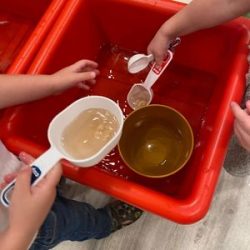
Set out two bowls, one on the left side of your child and the other on the right side. Have one bowl empty and the other full. Use a small measuring cup to transfer the water back and forth.
Give your child a bowl of water and a large cup with a handle. Have your child hold the cup handle with one hand, and let her transfer water with the other hand. This will help her not to transfer the measuring cup at midline
Have multiple bowls of water and make them different colors with food coloring. Have your child match the colored water to the same colored bowl (if you have them) or use masking tape and label each empty bowl with the color.
If you child seems to be favoring one side over the other, just move the bowls around to see if it will encourage crossing midline
Have different types of things to play with (spoons of different sizes, measuring spoons, measuring cups, eye droppers, squeeze bottles, etc.) place them in a container and have your child reach for what she wants, and put them back when she’s done.
Water Transfer Tutorial
Once you purchase the Water Transfer Tutorial and log in, you will have full access to all the content below this section.
The Functional Developmental Levels (FDL) are based on The PLAY Project and DIR/Floortime
FDL 1: Self Regulation & Shared Attention
FDL 2: Engagement & Relating
FDL 3: Intentionality & Two-Way Communication
FDL 4: Social Problem-Solving & Mood Regulation
FDL 5: Creating Symbols & Using Words & Ideas
FDL 6: Emotional Thinking, Logic & Sense of Reality
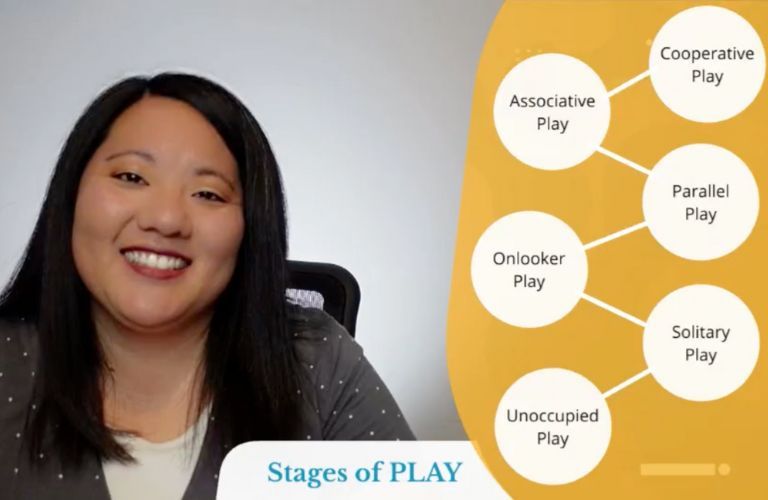
Stages of Play: 1-6
This activity is great for kids primarily participating in stages: 1-6
The Stages of Play come from Parten’s Stages of Social Play.
Stage 1: Unoccupied Play
Stage 2: Solitary Play
Stage 3: Onlooker Play
Stage 4: Parallel Play
Stage 5: Associative Play
Stage 6: Cooperative Play
Sensory Input: Tactile
This activity includes: tactile
Our senses include more than the usual 5 senses. Some kids may seek certain types of sensory input and/or avoid other types.
Visual: Sight
Auditory: Sound
Olfactory: Smell
Oral: Taste (Gustatory) and using the mouth to speak, make sounds, eat, chew, drink, etc.
Tactile: Touch
Vestibular: How we process information about movement, gravity, and balance. We receive this information through the inner ear.
Proprioceptive: How we process information about body position and body parts. We receive this information through our muscles, ligaments, and joints.
Areas of Development: Communication, Cognitive, Motor
This activity is good for targeting the following developmental skills: communication, cognitive, motor
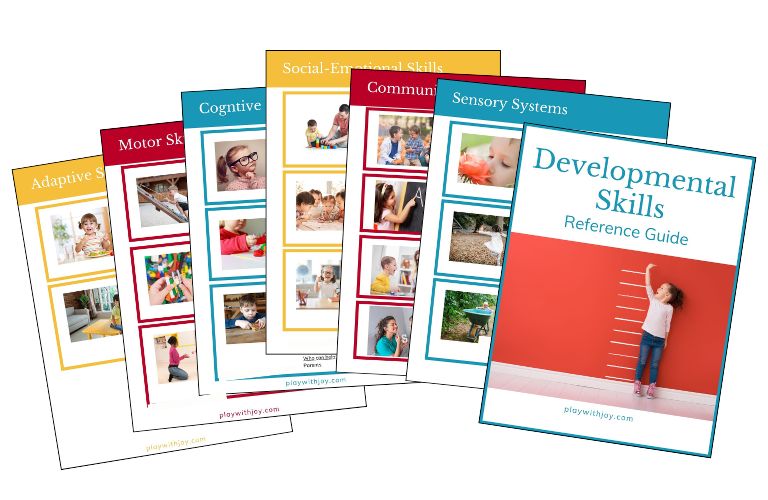
These are the main areas of child development addressed in the Early Intervention Tutorials
Communication: receptive language, expressive language, listening, two-way communication
Cognitive skills: cause & effect, literacy, math, science, problem solving, perception and concept
Executive functioning: emotional control, flexibility, perseverance, self-monitoring, organization, planning, response inhibition, attention, task initiation, time management, working memory
Motor skills: fine motor, gross motor, perceptual motor
Social-emotional skills: peer interaction, self concept & social role, pretend play, behavior, group activities
Adaptive skills: self-care, personal responsibility
Supply Ideas
Bowls
Spoons
Measuring cups
Eye droppers
Instructions
Fill some bowls with water
Give your child different spoons, cups, or eye droppers
Allow your child to explore (even if it gets messy)
Links
As an Amazon affiliate, I earn from qualifying purchases at no cost to you.
Science Kit-I highly recommend this science kit. It’s so much fun for kids. you can just use water, or you can add food coloring to mix colors. You can also add vinegar and baking soda for some variety. It’s fun with the different beakers, eye droppers, tubes, and microscope.
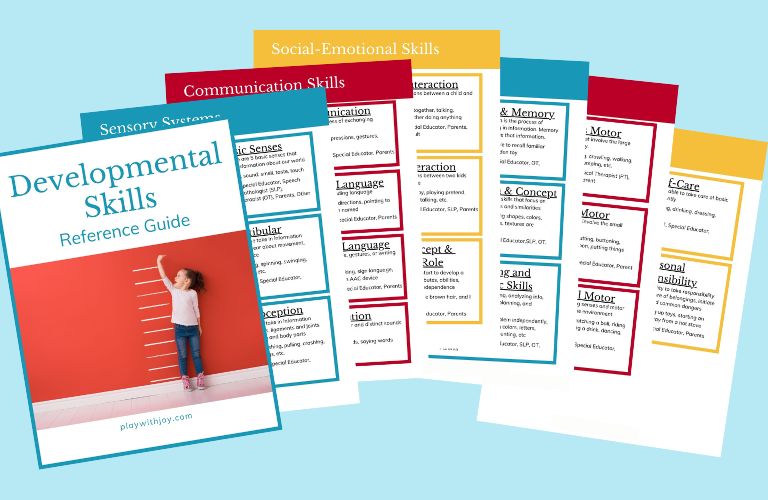
Get Your Free Developmental Skills Reference Guide
Parents, educators, and therapists – Add this to your toolbox to better understand key areas of child development. Plus get extra tips, activities and strategies to your inbox.
Unsubscribe at any time. See Privacy Policy for more details.