Let’s talk about the Who, What, When, Where, Why, and How’s of Early intervention. Let’s do it in this order, though.
What is Early Intervention?
Who needs Early Intervention?
Why is Early Intervention Important?
When should Early Intervention be provided?
Where can you get Early Intervention?
How do you get started with Early Intervention?
What is Early Intervention?
Early Intervention can address any of the following developmental areas
speech, language, and communication
social skills
cognitive skills
gross motor skills
fine motor skills
adaptive skills
Early Intervention is the help that kids need when they have a developmental delay or disability as a young child. When a child is lacking skills that are typically age appropriate, Early Intervention can support the development of the skills they need to progress.
Who needs Early Intervention?
Early Intervention is typically for kids ages 0-6 years old. Basically, until a child is in kindergarten. If a child has any delays in the areas listed in the above section, they should receive Early Intervention.
I’ll talk more about this in the ‘Where’ section, but a child may have delays, but if it’s not significant enough, they may not qualify for state services. This does not mean that the child does not need Early Intervention.
If you, as a parent or educator have concerns about a child’s development, there are things you can do to help the child, whether or not they qualify for state services.
Why is Early Intervention Important?
Think of all the things that a child learns between the ages of 0-6. The brain is growing at such a high rate during the first 6 years of life. We want to take advantage of that.
Kids will have a natural progression, but if we are able to add to it with methods and techniques that will help them grow in the right direction, then let’s do it!
I’ll be honest, before I started working in Early Intervention and Preschool, I had no idea that it was important. I was used to working with adults, I had never looked into Early Intervention before. I think a lot of people are in the same boat, if they’ve never had a need, then they never had a reason to look into it.
The more we put into the early education of our kids with special needs, the less they will need as they get older. It doesn’t mean that they won’t need anything as they get older, but they will need less because they will gain valuable skills at a younger age that they can take with them.
Ok, if you’re reading this and you’re not sure whether or not your child has a developmental delay, you can still learn techniques to help your child. The fact that you’re reading this post means you probably have some concerns. Don’t discount your feelings and intuition. Some doctors will say “wait it out” and I’m going to say “don’t.”
Now, if you’re a parent with a child older than 6 and didn’t have the opportunity to get Early Intervention. That’s ok! Don’t get hung up on it. You can start today and go forward, knowing that you always have and always will want the best for your child. As I said earlier, a child’s brain is developing rapidly before the age of 6, but that obviously doesn’t mean all development stops as they get older. There’s still plenty room to learn and grow!
When should Early Intervention be provided?
I kind of already talked about this, but a child should receive Early Intervention before the age of 6.
Where can you get Early Intervention?
By law, if your child qualifies for early intervention services, you will receive it for free within your state if you are living in the United States. If you are having concerns about your child’s development, you can go to the CDC’s website to find out who to contact in your area. Sometimes there’s a wait to get in for an appointment, so the earlier you do it, the better.
Schools are great, and I loved teaching in the school setting. There are always going to be limits, no matter how much you wish there weren’t. Schools need to show that they are giving a Free Appropriate Public Education (FAPE), they do not need to show that they are performing miracles.
Services will most likely look different wherever you are vs. where I am, and 0-3 services will also be different than 3-6 services. Some may be in home, and others may be in a class. There will be times when you may want more intervention or therapies for your child, and that’s great. That’s when programs like mine come into play.
The other thing to know about state services is that in order to qualify (depending on the state), a child may need a specific diagnosis or to do testing with Early Intervention. For example, in Utah where I live, a child has to score in the 7th percentile or below in one or more domains of the test.
Well, what if you’re on a 6 month waiting list to get a diagnosis? Or what if your child scores in the 10th percentile? Then what? My recommendation would be to seek out private services to help your child. You can find different therapists to help, and in certain areas of development, you can get parent training to help you implement it in the home.
There are a lot of therapies out there, and it can be overwhelming and confusing. I have had the opportunity to work with some incredible professionals offering a variety of interventions, and I honestly feel that all kids are so different, and their needs are different regardless of the diagnosis, that you have to find out what will work for you.
Here is a list of some of my preferred types of intervention.
DIR/Floortime or The Play Project. I was a Play Project Consultant for years (2007-2025) I like that it trains parents to be the therapists. I like that it focuses on relationships, particularly family relationships. I like that it’s easy to implement in every day activities, and that it’s all play-based, which is how kids learn at this age.
Occupational Therapist. Occupational therapists can help with fine motor skills as well as sensory integration. I have worked with some of the best, you definitely need to make sure that your OT is skilled at working with kids on the spectrum, and are trained in sensory integration.
Speech and Language Pathologist. Speech therapy is great for kids that may have a language delay. I have worked with so many amazing SLPs, and highly respect them and have learned a lot from them.
Physical Therapist. If your child has delays in gross motor skills, seek out a pediatric physical therapist. I haven’t had the opportunity to work with too many PTs, but I have learned that there’s a difference between pediatric PTs and adult PTs, and it’s best to work with one familiar with working with kids. A child is not a small adult.
Special Educator. I am also a special educator working with kids privately. Special educators can help with all the different developmental skills, but if there is a specific skill that needs more attention, I definitely recommend going to the specified therapist. I have just been lucky to work on some amazing multi-disciplinary teams and can collaborate with them.
How do you get started with Early Intervention?
Unfortunately, there are a lot of waiting lists out there for Early Intervention services. The first step is always to get on them—but I know how frustrating it can feel to wait while your child could be gaining skills right now.
Hearing parents express that frustration inspired me to think about ways I could help immediately. That’s one of the reasons I created the resources on this website. The Early Intervention tutorials at playwithjoy.com/shop give you practical, hands-on strategies that you can start using today—no waiting required.
Whether you’re a parent, educator, or therapist, these tutorials are designed to help children build skills in communication, play, regulation, motor development, social interaction, and daily routines—all in ways that feel natural and fun.
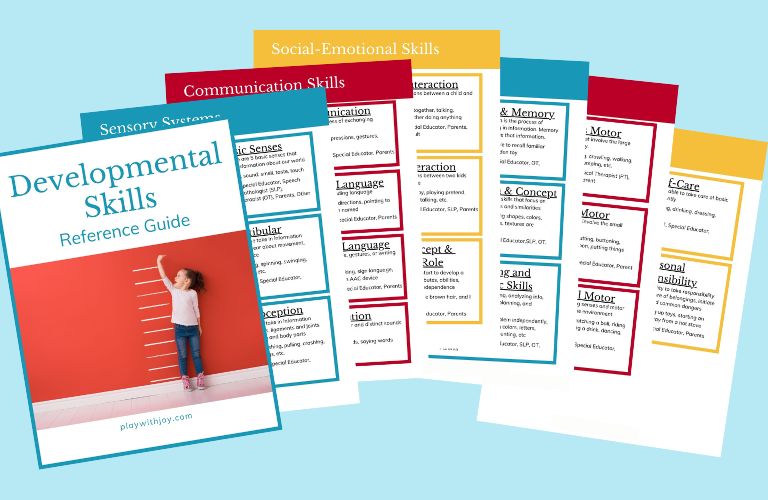
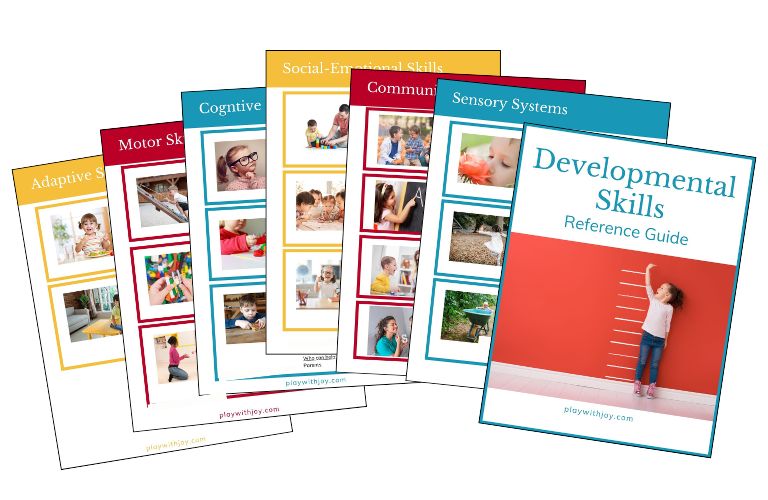
Get Your Free Developmental Skills Reference Guide
Parents, educators, and therapists – Add this to your toolbox to better understand key areas of child development. Plus get extra tips, activities and strategies to your inbox.
Unsubscribe at any time. See Privacy Policy for more details.